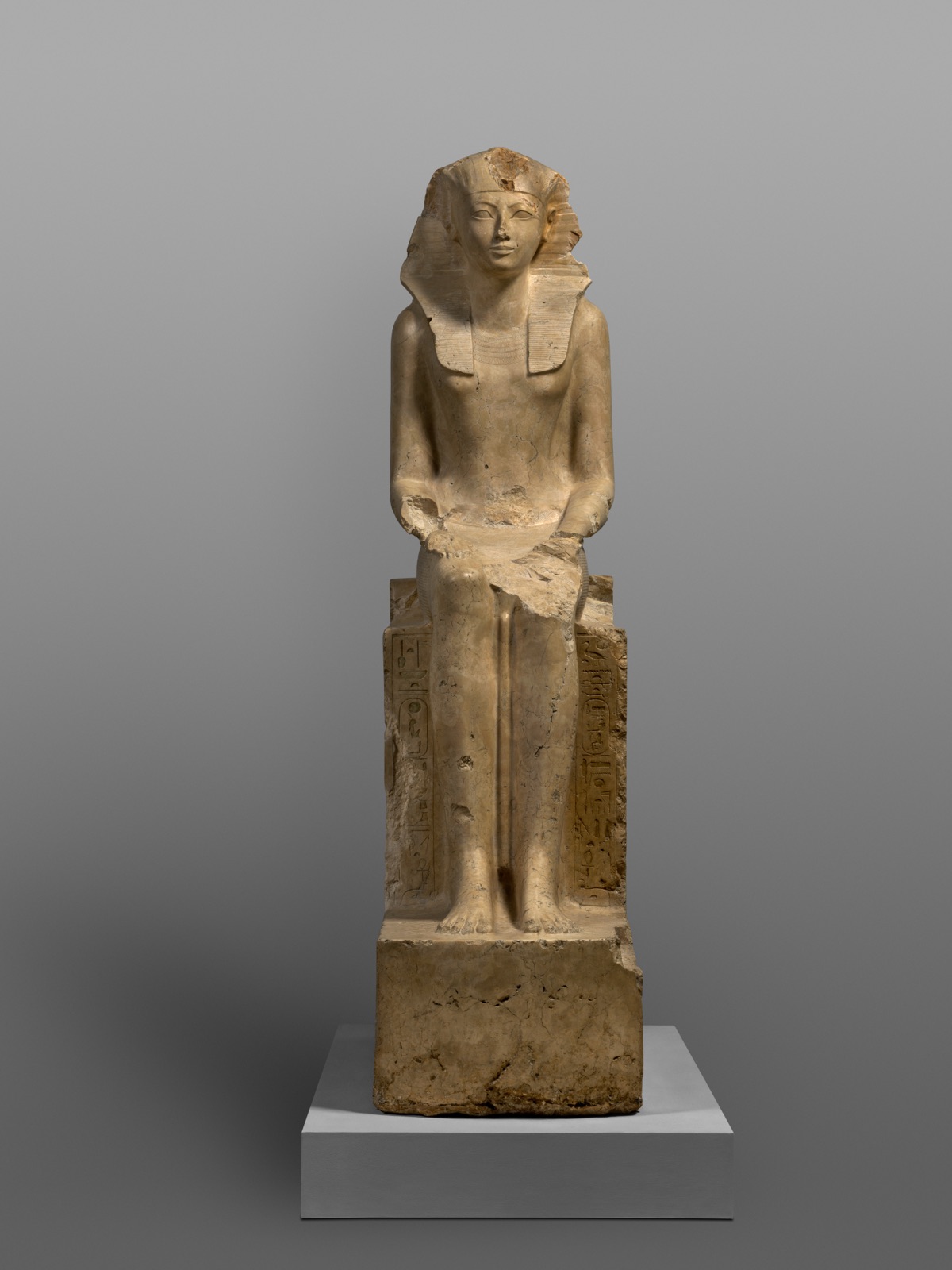
Seated statue of Hatshepsut, the Metropolitan Museum of Art, New YorkThe Metropolitan Museum of Art, Rogers Fund, 1929 · Open Access, CC0Image rights
Piece·royal seated statue·Abroad
Seated statue of Hatshepsut
A woman king, smashed and rebuilt
- Date
- c. 1479–1458 BCE; 18th Dynasty
- Where it is now
- Metropolitan Museum of Art, New York, USA
Documented: This story has clear published sources.
This story’s sources (2 sources), each opens its own page:
Scholars’ theory: An explanation scholars take seriously, but not settled.Folk tale: A story people tell; we give its origin and what is established.
The story
After Hatshepsut died, her statues were smashed and dumped in pits near her temple. In the 1920s the Met's team collected thousands of fragments and pieced her back together. In 1929 the museum swapped with Berlin to get the statue's lower part, which Berlin had owned since 1845.
How it left
Fragments excavated by the Met's Egyptian Expedition (1920s) went to New York in the division of finds; others went to Cairo. The lower part had been taken to Berlin in 1845 and was obtained by exchange in 1929.
Requests to return it
No formal Egyptian request found.
What we know for sure
- Type
- royal seated statue
- Material
- indurated limestone, paint
- Date
- c. 1479–1458 BCE; 18th Dynasty
- Found
- Deir el-Bahari, Luxor (fragments in a quarry and dumps near her temple); 1920s (lower part found in the 1840s); Metropolitan Museum of Art expedition (Herbert Winlock)
- Now
- Metropolitan Museum of Art, New York, USA
- Inventory no.
- 29.3.2
Sources
Each source opens its own page.
Image rights
Seated Statue of Hatshepsut, 29.3.2. The Metropolitan Museum of Art, Rogers Fund, 1929 · Open Access, CC0. Published by the museum through its Open Access programme, free to use without restriction.
Also shown in
Your name in hieroglyphs · SHETA: a puzzle game from SHATATiON, with the same signs. Meet SHETA