Stories
206 short stories from their sources: gods, kings, customs and papyri, and the things people say that are wrong.
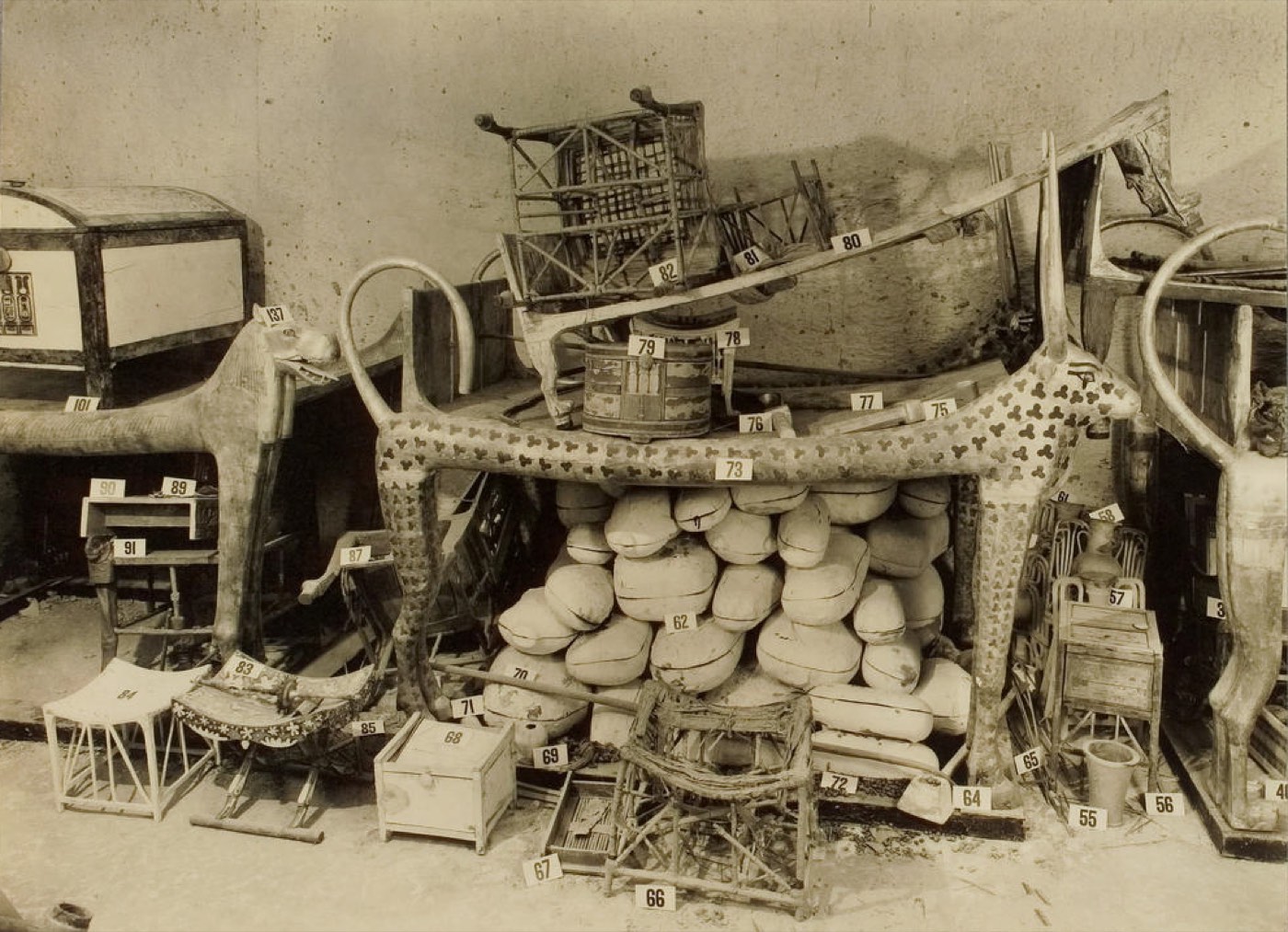
The antechamber as it was found, December 1922Harry Burton, 1922 · Public domain
Featured story·Common but wrong
Tutankhamun’s curse?
The newspapers said the tomb killed those who opened it. A study that followed the lives of those who were there found no statistical evidence of that.
A special corner
Common but wrong
Things often said about ancient Egypt, with what the sources say.
Common but wrong
The ancient Egyptians were the pharaohs?
In fact: Pharaoh was a title of the king, from pr-ꜥꜣ, the great house, which first meant the palace. The people were Egyptians, and they called their land Kemet, the black land.
Common but wrong: Something many people say; the correction comes from published sources.
This story’s sources (3 sources), each opens its own page:
Common but wrong
Slaves built the pyramids?
In fact: At Giza, archaeologists found a town where the builders lived and a cemetery where they were buried, close to the pyramids. Mark Lehner reads its long galleries as barracks for a rotating workforce: not slaves, at least in the modern sense.
Common but wrong: Something many people say; the correction comes from published sources.
This story’s sources (2 sources), each opens its own page:
Common but wrong
Aliens built the pyramids?
In fact: The evidence is very much of this Earth: a town where the builders lived near Giza, and at Wadi el-Jarf the oldest papyri ever found in Egypt, among them the diary of Merer, an official who worked on the Great Pyramid under Khufu. Not one alien in his logbook.
Common but wrong: Something many people say; the correction comes from published sources.
This story’s sources (2 sources), each opens its own page:
Common but wrong
Tutankhamun’s curse struck down those who opened his tomb?
In fact: A 2002 study in the BMJ followed 44 Westerners who were there and found no statistical evidence that entering the tomb was linked to a shorter life in that group. Lady Evelyn Herbert went in and lived to 78; Lord Carnarvon died of an infected mosquito bite he had nicked while shaving.
Common but wrong: Something many people say; the correction comes from published sources.
This story’s sources (one source), each opens its own page:
Common but wrong
Each hieroglyph is one letter of an alphabet?
In fact: The script mixed signs for sounds, signs for ideas and signs for whole words. This page uses only the sound signs, the way scribes spelled foreign names.
Common but wrong: Something many people say; the correction comes from published sources.
This story’s sources (one source), each opens its own page:
Common but wrong
Early kings weren’t called pharaoh
Khufu, who built the Great Pyramid, was never called pharaoh in his lifetime. The word was not used for the ruler until the New Kingdom, more than a thousand years later. Before that, he was simply the king.
Common but wrong: Something many people say; the correction comes from published sources.
This story’s sources (one source), each opens its own page:
Common but wrong
100,000 workers?
Herodotus, writing some 2,000 years after the Great Pyramid, said 100,000 men built it. Modern studies of the builders’ town point to far fewer: a few thousand at a time, some of them rotating crews.
Common but wrong: Something many people say; the correction comes from published sources.
The source hedges on this point, so it is worded with care.
This story’s sources (one source), each opens its own page:
Common but wrong
Tutankhamun, the great king?
Tutankhamun ruled for only about nine years and died young. He is world-famous not for his deeds but because his small tomb is the only royal tomb in the Valley of the Kings found nearly intact.
Common but wrong: Something many people say; the correction comes from published sources.
This story’s sources (one source), each opens its own page:
Common but wrong
Was Cleopatra of Egyptian lineage?
Her royal line, the Ptolemies, was Macedonian Greek and had ruled Egypt for nearly three centuries. Her mother’s identity is debated, and some scholars suggest an Egyptian priestly family. So: a Greek dynasty, possibly some Egyptian ancestry.
Common but wrong: Something many people say; the correction comes from published sources.
The source hedges on this point, so it is worded with care.
This story’s sources (2 sources), each opens its own page:
Common but wrong
Luxor, a third of everything?
A popular saying, but no study or official count backs it; nobody has counted all the world’s monuments. What is true: Ancient Thebes, with Karnak, Luxor Temple and the Valley of the Kings, has been a UNESCO World Heritage Site since 1979.
Common but wrong: Something many people say; the correction comes from published sources.
This story’s sources (one source), each opens its own page:
Common but wrong
Ramesses II’s passport?
The mummy of Ramesses II really did fly to Paris in 1976 for treatment. But the famous passport picture online is a digital illustration made in 2018, and fact-checkers found no evidence a passport was ever issued.
Common but wrong: Something many people say; the correction comes from published sources.
This story’s sources (one source), each opens its own page:
This story is about human remains.
In 1976 French scientists found fungus damaging Ramesses II's mummy. Egypt agreed to send it to Paris; it was received with military honours, treated with gamma radiation at the Musée de l'Homme, and returned in May 1977. The passport story is a myth.
Common but wrong
The Great Pyramid came first?
Not quite. Djoser’s Step Pyramid at Saqqara is older, the very first pyramid, and Khufu’s father Sneferu built several more before his son raised the Great Pyramid.
Common but wrong: Something many people say; the correction comes from published sources.
This story’s sources (2 sources), each opens its own page:
Every story
Gods & myths
A goddess wearing a throne
Isis’s oldest crown was not gold or feathers but an empty throne. Her name may come from Eset, the seat, and the empty throne recalled her murdered husband, Osiris.
Documented: This story has clear published sources.
The source hedges on this point, so it is worded with care.
This story’s sources (one source), each opens its own page:
Scholars’ theory: An explanation scholars take seriously, but not settled.Folk tale: A story people tell; we give its origin and what is established.
Kings & queens
Cleopatra, closer to the Moon
Cleopatra VII was born in 69 BCE, almost 2,500 years after the Great Pyramid was finished (around 2560 BCE). The first Moon landing, in 1969, came about 2,040 years after her birth: she lived closer to it than to the pyramid.
Documented: This story has clear published sources.
This story’s sources (2 sources), each opens its own page:
Scholars’ theory: An explanation scholars take seriously, but not settled.Folk tale: A story people tell; we give its origin and what is established.
Customs & beliefs
The first recorded strike
At Deir el-Medina, the village of the royal tomb builders, pay was 18 days late under Ramesses III, around 1159 BCE. The workers laid down their tools and staged a sit-in by the temple of Thutmose III: the earliest recorded strike in history.
Documented: This story has clear published sources.
This story’s sources (one source), each opens its own page:
Scholars’ theory: An explanation scholars take seriously, but not settled.Folk tale: A story people tell; we give its origin and what is established.
The papyrus bank
No vowels, please
Egyptian writing showed the consonants, not the vowels, much like Arabic written without its vowel marks. That’s why we leave out the short vowels of Arabic names too.
Documented: This story has clear published sources.
This story’s sources (one source), each opens its own page:
Scholars’ theory: An explanation scholars take seriously, but not settled.Folk tale: A story people tell; we give its origin and what is established.
Tombs
The small tomb with 5,000 treasures
Tutankhamun’s tomb is modest in size and decoration next to other royal tombs. Yet it held about 5,000 objects stacked tightly together, and it is the only royal tomb in the valley found relatively intact.
Documented: This story has clear published sources.
This story’s sources (one source), each opens its own page:
Scholars’ theory: An explanation scholars take seriously, but not settled.Folk tale: A story people tell; we give its origin and what is established.
Temples
Sunlight that skips one god
On 22 February and 22 October, sunrise reaches deep inside Abu Simbel and lights three of the four statues in the sanctuary. Ptah, linked to the underworld, stays in shadow.
Documented: This story has clear published sources.
This story’s sources (one source), each opens its own page:
Scholars’ theory: An explanation scholars take seriously, but not settled.Folk tale: A story people tell; we give its origin and what is established.
Pyramids & the Sphinx
The tallest for over 3,000 years
The Great Pyramid stayed the tallest structure made by human hands for more than 3,000 years. Who beat it? Some say the spire of Lincoln Cathedral, around 1300; others, the Eiffel Tower in 1889.
Documented: This story has clear published sources.
This story’s sources (one source), each opens its own page:
Scholars’ theory: An explanation scholars take seriously, but not settled.Folk tale: A story people tell; we give its origin and what is established.
Obelisks
The giant that cracked
In a quarry at Aswan lies an obelisk never finished. Had it been completed, it would have stood about 42 meters tall and weighed some 1,168 tonnes. Cracks in the stone stopped the work.
Documented: This story has clear published sources.
This story’s sources (one source), each opens its own page:
Scholars’ theory: An explanation scholars take seriously, but not settled.Folk tale: A story people tell; we give its origin and what is established.
Egypt in world museums
Description is useless
When the bust of Nefertiti was found at Amarna in 1912, the excavator Ludwig Borchardt wrote in his diary: description is useless, must be seen. Made around 1340 BCE, it is now in Berlin’s Neues Museum.
Documented: This story has clear published sources.
This story’s sources (one source), each opens its own page:
Scholars’ theory: An explanation scholars take seriously, but not settled.Folk tale: A story people tell; we give its origin and what is established.
Grand Egyptian Museum
Twenty years in the making
The Grand Egyptian Museum had its grand opening ceremony on Saturday 1 November 2025 and welcomed the public from 4 November, after about two decades of work and a cost of around one billion dollars.
Documented: This story has clear published sources.
This story’s sources (2 sources), each opens its own page:
- Al Jazeera (4 Nov 2025): A look inside Egypt’s newly unveiled Grand Egyptian Museum
- Arab News Japan (2 Nov 2025): GEM officially opens
Scholars’ theory: An explanation scholars take seriously, but not settled.Folk tale: A story people tell; we give its origin and what is established.
Nature & animals
Eight million
In the Catacombs of Anubis at Saqqara, a Cardiff University team estimated nearly 8 million mummified animals, mostly dogs and puppies, offered to the god Anubis.
Documented: This story has clear published sources.
This story’s sources (2 sources), each opens its own page:
- NBC News, reporting Nicholson et al., Antiquity (2015)
- Nicholson, Ikram and Mills, The Catacombs of Anubis at North Saqqara, Antiquity 89 (2015)
Scholars’ theory: An explanation scholars take seriously, but not settled.Folk tale: A story people tell; we give its origin and what is established.
Gods & myths
Isis in Roman London
The worship of Isis traveled far beyond the Nile. It spread across the Roman world, and the Romans even honored her at Londinium, the town that became London.
Documented: This story has clear published sources.
The source hedges on this point, so it is worded with care.
This story’s sources (one source), each opens its own page:
Scholars’ theory: An explanation scholars take seriously, but not settled.Folk tale: A story people tell; we give its origin and what is established.
Kings & queens
Cleopatra spoke Egyptian
Cleopatra VII came from the Ptolemies, a dynasty of Macedonian Greek origin. Her forebears ruled Egypt for nearly three centuries without learning its language; she was fluent in Egyptian, as well as her native Greek and other languages.
Documented: This story has clear published sources.
This story’s sources (one source), each opens its own page:
Scholars’ theory: An explanation scholars take seriously, but not settled.Folk tale: A story people tell; we give its origin and what is established.
Customs & beliefs
Rights ahead of their time
Egyptian women could own and sell property in their own name, bring cases to court and serve as witnesses, and either spouse could end a marriage.
Documented: This story has clear published sources.
This story’s sources (one source), each opens its own page:
Scholars’ theory: An explanation scholars take seriously, but not settled.Folk tale: A story people tell; we give its origin and what is established.
The papyrus bank
One decree, three scripts
The Rosetta Stone (196 BCE) carries one decree of a priestly council in three versions: hieroglyphic, Demotic and Greek. Comparing them helped scholars unlock the hieroglyphs.
Documented: This story has clear published sources.
This story’s sources (one source), each opens its own page:
Scholars’ theory: An explanation scholars take seriously, but not settled.Folk tale: A story people tell; we give its origin and what is established.
Tombs
Only one room was painted
In Tutankhamun’s tomb, only the walls of the burial chamber are decorated. Scholars think the tomb may have been adapted from an earlier, non-royal one.
Documented: This story has clear published sources.
This story’s sources (one source), each opens its own page:
Scholars’ theory: An explanation scholars take seriously, but not settled.Folk tale: A story people tell; we give its origin and what is established.
Temples
A queen as big as kings
At the small temple of Abu Simbel, Nefertari’s statues on the facade are the same size as those of Ramesses II, a very rare honor for a queen.
Documented: This story has clear published sources.
This story’s sources (one source), each opens its own page:
Scholars’ theory: An explanation scholars take seriously, but not settled.Folk tale: A story people tell; we give its origin and what is established.
Pyramids & the Sphinx
Bread and beer
Ancient texts tell us that workers on royal projects received their rations as bread and beer. In the pyramid builders’ town at Giza, archaeologists found bakeries made for production on a grand scale.
Documented: This story has clear published sources.
This story’s sources (one source), each opens its own page:
Scholars’ theory: An explanation scholars take seriously, but not settled.Folk tale: A story people tell; we give its origin and what is established.
Obelisks
Hatshepsut’s 300-ton needle
At Karnak, Hatshepsut’s obelisk still stands almost 30 meters tall and weighs more than 300 tons.
Documented: This story has clear published sources.
This story’s sources (one source), each opens its own page:
Scholars’ theory: An explanation scholars take seriously, but not settled.Folk tale: A story people tell; we give its origin and what is established.
Egypt in world museums
The oldest Egyptian museum abroad
The Museo Egizio in Turin, founded in 1824, is the world’s oldest museum devoted entirely to ancient Egyptian culture. It holds about 40,000 objects, and only around 3,300 are on display.
Documented: This story has clear published sources.
This story’s sources (one source), each opens its own page:
Scholars’ theory: An explanation scholars take seriously, but not settled.Folk tale: A story people tell; we give its origin and what is established.
Grand Egyptian Museum
A museum for one civilization
Egypt’s Ministry of Tourism and Antiquities calls the GEM the largest museum in the world dedicated to a single civilization. It stands about 2 km from the Giza pyramids.
Documented: This story has clear published sources.
This story’s sources (2 sources), each opens its own page:
- Egypt’s Ministry of Tourism and Antiquities: The Conservation Laboratory of the GEM
- Al Jazeera (4 Nov 2025)
Scholars’ theory: An explanation scholars take seriously, but not settled.Folk tale: A story people tell; we give its origin and what is established.
Nature & animals
A flower that sleeps at night
The blue lotus closes at night and opens again in the morning. To the Egyptians that made it a picture of the sun reborn each day, and they prized it above the white lotus for its sweet scent.
Documented: This story has clear published sources.
This story’s sources (one source), each opens its own page:
Scholars’ theory: An explanation scholars take seriously, but not settled.Folk tale: A story people tell; we give its origin and what is established.
Gods & myths
The deadliest party game
The Egyptians told that Set had a beautiful chest made to Osiris’s exact size, then promised it at a party to whoever fit inside. Osiris lay down, and Set shut the lid.
Documented: This story has clear published sources.
This story’s sources (one source), each opens its own page:
Scholars’ theory: An explanation scholars take seriously, but not settled.Folk tale: A story people tell; we give its origin and what is established.
Kings & queens
A king on a makeup palette
One of the most famous images of Egypt’s early unification is carved on a palette, a stone for grinding makeup. The Narmer Palette, about 64 cm tall, dates to around 3150 BCE.
Documented: This story has clear published sources.
This story’s sources (one source), each opens its own page:
Scholars’ theory: An explanation scholars take seriously, but not settled.Folk tale: A story people tell; we give its origin and what is established.
Customs & beliefs
A game thousands of years old
Senet is among the oldest board games we know: its first clear picture dates to around 2620 BCE, and broken boards that may be senet come from even older burials. Play runs deep here, and SHETA is a game too.
Documented: This story has clear published sources.
This story’s sources (one source), each opens its own page:
Scholars’ theory: An explanation scholars take seriously, but not settled.Folk tale: A story people tell; we give its origin and what is established.
The papyrus bank
It began with two names
The cartouches of Ptolemy and Cleopatra were among the first keys: Thomas Young found Ptolemy, and a copy of the Philae obelisk confirmed Champollion’s reading of Cleopatra. He announced the decipherment in 1822, using the same spelling by sound as this page.
Documented: This story has clear published sources.
This story’s sources (2 sources), each opens its own page:
Scholars’ theory: An explanation scholars take seriously, but not settled.Folk tale: A story people tell; we give its origin and what is established.
Tombs
None seeing, none hearing
Having seen the old pyramids robbed, New Kingdom kings hid their tombs underground in a remote desert valley. The official who dug the first known one there boasted it was done with none seeing, none hearing.
Documented: This story has clear published sources.
This story’s sources (one source), each opens its own page:
Scholars’ theory: An explanation scholars take seriously, but not settled.Folk tale: A story people tell; we give its origin and what is established.
Temples
The giant that fell
One of the four seated giants on Abu Simbel’s facade broke in an earthquake in ancient times. Its pieces still lie on the ground where they fell.
Documented: This story has clear published sources.
This story’s sources (one source), each opens its own page:
Scholars’ theory: An explanation scholars take seriously, but not settled.Folk tale: A story people tell; we give its origin and what is established.
Pyramids & the Sphinx
The first pyramid was a stack
The very first pyramid, Djoser’s at Saqqara, is six mastaba tombs stacked one on top of another. Designed by Imhotep, it is the oldest known stone structure of ancient Egypt.
Documented: This story has clear published sources.
This story’s sources (one source), each opens its own page:
Scholars’ theory: An explanation scholars take seriously, but not settled.Folk tale: A story people tell; we give its origin and what is established.
Obelisks
Twins split by the sea
Luxor Temple was fronted by a pair of 25-meter obelisks of Ramesses II. One still stands there; its twin has stood in the Place de la Concorde in Paris since 1836.
Documented: This story has clear published sources.
This story’s sources (one source), each opens its own page:
Scholars’ theory: An explanation scholars take seriously, but not settled.Folk tale: A story people tell; we give its origin and what is established.
Egypt in world museums
A rock temple in Turin
Egypt gave Italy the rock temple of Ellesiya to thank it for helping save the temples of Nubia. It was cut into 66 blocks, rebuilt inside the Turin museum, and opened on 4 September 1970.
Documented: This story has clear published sources.
This story’s sources (one source), each opens its own page:
Scholars’ theory: An explanation scholars take seriously, but not settled.Folk tale: A story people tell; we give its origin and what is established.
Grand Egyptian Museum
All of Tutankhamun, at last
For the first time since the tomb was found in 1922, Tutankhamun’s treasures, more than 5,000 objects, are shown together in one place, in galleries of about 7,500 square meters at the GEM.
Documented: This story has clear published sources.
This story’s sources (2 sources), each opens its own page:
- Arab News Japan (2 Nov 2025)
- Egypt’s Ministry of Tourism and Antiquities: The Conservation Laboratory of the GEM
Scholars’ theory: An explanation scholars take seriously, but not settled.Folk tale: A story people tell; we give its origin and what is established.
Nature & animals
A beetle that pushes the sun
The Egyptians watched the scarab roll its ball of dung and saw the sun crossing the sky. Young beetles came out of the ball, so the scarab, as the god Khepri, became a sign of rebirth.
Documented: This story has clear published sources.
This story’s sources (one source), each opens its own page:
Scholars’ theory: An explanation scholars take seriously, but not settled.Folk tale: A story people tell; we give its origin and what is established.
Gods & myths
Gardens shaped like a god
To celebrate Osiris coming back to life, Egyptians planted grain in mud shaped like the god. When the seeds sprouted, Osiris seemed to rise again in green.
Documented: This story has clear published sources.
This story’s sources (one source), each opens its own page:
Scholars’ theory: An explanation scholars take seriously, but not settled.Folk tale: A story people tell; we give its origin and what is established.
Kings & queens
The commoner who became a god
Imhotep was born a commoner and became the architect of Djoser’s Step Pyramid. About two thousand years later, Egyptians worshiped him as a god of wisdom and medicine.
Documented: This story has clear published sources.
This story’s sources (one source), each opens its own page:
Scholars’ theory: An explanation scholars take seriously, but not settled.Folk tale: A story people tell; we give its origin and what is established.
Customs & beliefs
365 days
The Egyptian civil year had 12 months of 30 days, followed by five extra days: 365 in all. Since the solar year is a quarter of a day longer, the calendar slipped by one day every four years.
Documented: This story has clear published sources.
This story’s sources (one source), each opens its own page:
Scholars’ theory: An explanation scholars take seriously, but not settled.Folk tale: A story people tell; we give its origin and what is established.
The papyrus bank
More than 3,500 years
Hieroglyphic writing appeared around 3200 BCE. The last dated hieroglyphic inscription was carved at Philae, near Aswan, in 394 CE: more than 3,500 years later.
Documented: This story has clear published sources.
This story’s sources (2 sources), each opens its own page:
Scholars’ theory: An explanation scholars take seriously, but not settled.Folk tale: A story people tell; we give its origin and what is established.
Tombs
Not only kings in the Valley
The Valley of the Kings holds more than 60 tombs, plus about 20 unfinished pits. And the name is not quite right: some royal family members and a few high officials were buried there too.
Documented: This story has clear published sources.
This story’s sources (one source), each opens its own page:
Scholars’ theory: An explanation scholars take seriously, but not settled.Folk tale: A story people tell; we give its origin and what is established.
Temples
A forest of 134 columns
Karnak’s great hypostyle hall is a forest of 134 stone columns. Most are 15 meters tall, and the twelve in the middle reach 21 meters.
Documented: This story has clear published sources.
This story’s sources (one source), each opens its own page:
Scholars’ theory: An explanation scholars take seriously, but not settled.Folk tale: A story people tell; we give its origin and what is established.
Pyramids & the Sphinx
The pyramid that changed its mind
Sneferu’s Bent Pyramid at Dahshur began at a steep 55 degrees, then the builders switched to 43 degrees halfway up because the structure was becoming unstable. The kink is still there.
Documented: This story has clear published sources.
This story’s sources (one source), each opens its own page:
Scholars’ theory: An explanation scholars take seriously, but not settled.Folk tale: A story people tell; we give its origin and what is established.
Obelisks
An obelisk for a clock
France’s King Louis Philippe gave Muhammad Ali Pasha a copper clock tower, which still stands in the courtyard of his mosque at the Cairo Citadel. Muhammad Ali’s gift in return was the Luxor obelisk now in Paris.
Documented: This story has clear published sources.
This story’s sources (one source), each opens its own page:
Scholars’ theory: An explanation scholars take seriously, but not settled.Folk tale: A story people tell; we give its origin and what is established.
Egypt in world museums
A temple in a Madrid park
In 1968 Egypt gave Spain the Temple of Debod, partly in thanks for its help saving the Abu Simbel temples. It was rebuilt in Madrid’s Parque del Oeste and opened in 1972.
Documented: This story has clear published sources.
The source hedges on this point, so it is worded with care.
This story’s sources (one source), each opens its own page:
Scholars’ theory: An explanation scholars take seriously, but not settled.Folk tale: A story people tell; we give its origin and what is established.
Grand Egyptian Museum
A giant hung in a cage
On 25 January 2018, the colossus of Ramesses II was moved into the museum’s atrium, hanging inside an iron cage so it could sway freely instead of feeling every bump of the road.
Documented: This story has clear published sources.
This story’s sources (one source), each opens its own page:
Scholars’ theory: An explanation scholars take seriously, but not settled.Folk tale: A story people tell; we give its origin and what is established.
Nature & animals
Four million birds
Between about 650 and 250 BCE, Egyptians mummified millions of sacred ibises as offerings to Thoth: about four million at Tuna el-Gebel alone, and more than 1.5 million at Saqqara.
Documented: This story has clear published sources.
This story’s sources (one source), each opens its own page:
Scholars’ theory: An explanation scholars take seriously, but not settled.Folk tale: A story people tell; we give its origin and what is established.
Gods & myths
Saved by 7,000 jugs of beer
In one myth, Ra sent his fierce Eye to punish humanity, and she became the lioness Sekhmet who could not stop. Ra had 7,000 jugs of beer dyed red; she drank, slept, and woke up gentle.
Documented: This story has clear published sources.
This story’s sources (2 sources), each opens its own page:
Scholars’ theory: An explanation scholars take seriously, but not settled.Folk tale: A story people tell; we give its origin and what is established.
Kings & queens
A woman who ruled as king
Hatshepsut did not stay a queen. She took all the titles of a king and ruled for about 20 years, and her statues often show her in a king’s male dress.
Documented: This story has clear published sources.
This story’s sources (one source), each opens its own page:
Scholars’ theory: An explanation scholars take seriously, but not settled.Folk tale: A story people tell; we give its origin and what is established.
Customs & beliefs
A pregnancy test made of grain
A papyrus about 3,500 years old tells a woman to wet a bag of barley and a bag of wheat with her urine. If either sprouted, she was pregnant; if neither did, she was not.
Documented: This story has clear published sources.
This story’s sources (one source), each opens its own page:
Scholars’ theory: An explanation scholars take seriously, but not settled.Folk tale: A story people tell; we give its origin and what is established.
The papyrus bank
The gods’ words
The Egyptians called hieroglyphs medu netjer, the gods’ words: writing was thought to be a gift of the gods. The name hieroglyph came later, from Greek, and calls them holy.
Documented: This story has clear published sources.
This story’s sources (one source), each opens its own page:
Scholars’ theory: An explanation scholars take seriously, but not settled.Folk tale: A story people tell; we give its origin and what is established.
Tombs
The first fully painted tomb
The tomb of Seti I, father of Ramesses II, was the first in the Valley of the Kings to be decorated from end to end, and the first with a vaulted burial chamber. It is one of the longest and deepest there.
Documented: This story has clear published sources.
This story’s sources (one source), each opens its own page:
Scholars’ theory: An explanation scholars take seriously, but not settled.Folk tale: A story people tell; we give its origin and what is established.
Temples
A temple built over 2,000 years
Karnak was never finished in one go. Kings added to the temple of Amun from Intef II, around 2100 BCE, through the Ptolemies and even into Roman times: roughly two thousand years of building.
Documented: This story has clear published sources.
The source hedges on this point, so it is worded with care.
This story’s sources (one source), each opens its own page:
Scholars’ theory: An explanation scholars take seriously, but not settled.Folk tale: A story people tell; we give its origin and what is established.
Pyramids & the Sphinx
The Red Pyramid was white
Dahshur’s Red Pyramid gets its name from the rusty color of its stones. But it was once cased in pure white Tura limestone, which later builders carried off.
Documented: This story has clear published sources.
This story’s sources (one source), each opens its own page:
Scholars’ theory: An explanation scholars take seriously, but not settled.Folk tale: A story people tell; we give its origin and what is established.
Obelisks
New York’s oldest monument
The obelisk in Central Park was carved about 3,500 years ago to mark Thutmose III’s 30th year as king. Raised in 1881 before some 10,000 people, it is the oldest outdoor monument in New York City.
Documented: This story has clear published sources.
This story’s sources (one source), each opens its own page:
Scholars’ theory: An explanation scholars take seriously, but not settled.Folk tale: A story people tell; we give its origin and what is established.
Egypt in world museums
A ceiling blasted to Paris
The round zodiac on a ceiling of the Dendera temple was cut out with explosives in 1822 and sold to the French king for 150,000 francs. Some claimed it was 14,000 years old; it dates to the first century BCE. It is in the Louvre.
Documented: This story has clear published sources.
This story’s sources (one source), each opens its own page:
Scholars’ theory: An explanation scholars take seriously, but not settled.Folk tale: A story people tell; we give its origin and what is established.
Grand Egyptian Museum
A staircase six floors high
The Grand Staircase climbs six storeys and is lined with about 60 ancient pieces, so the climb itself is a walk through Egyptian history.
Documented: This story has clear published sources.
This story’s sources (one source), each opens its own page:
Scholars’ theory: An explanation scholars take seriously, but not settled.Folk tale: A story people tell; we give its origin and what is established.
Nature & animals
The sacred bird that vanished
DNA from ibis mummies suggests most of the birds were caught in the wild, not bred on farms. Today the sacred ibis, the bird of Thoth, is extinct in Egypt.
Documented: This story has clear published sources.
This story’s sources (one source), each opens its own page:
Scholars’ theory: An explanation scholars take seriously, but not settled.Folk tale: A story people tell; we give its origin and what is established.
Gods & myths
A monster that never stays dead
Every night, the Egyptians said, the serpent Apophis attacked the sun god’s boat in the underworld. Every night he lost, and by the next night he was whole again, waiting.
Documented: This story has clear published sources.
This story’s sources (2 sources), each opens its own page:
Scholars’ theory: An explanation scholars take seriously, but not settled.Folk tale: A story people tell; we give its origin and what is established.
Kings & queens
Trees brought from Punt
Hatshepsut’s ships brought living incense trees home from the land of Punt, among the earliest known tree transplants between lands. The stumps can still be seen at her temple.
Documented: This story has clear published sources.
The source hedges on this point, so it is worded with care.
This story’s sources (one source), each opens its own page:
Scholars’ theory: An explanation scholars take seriously, but not settled.Folk tale: A story people tell; we give its origin and what is established.
Customs & beliefs
Excused: a scorpion stung him
A work register from the village of the royal tomb builders lists why men missed work: illness, eye disease, a scorpion sting, or a wife’s or daughter’s period. One healer was often off making remedies.
Documented: This story has clear published sources.
This story’s sources (one source), each opens its own page:
Scholars’ theory: An explanation scholars take seriously, but not settled.Folk tale: A story people tell; we give its origin and what is established.
The papyrus bank
A rope that protects
The cartouche grew out of the round shen ring, a knotted loop of rope; the longer the king’s names became, the more it was stretched. Its meaning: protection by encircling.
Documented: This story has clear published sources.
This story’s sources (2 sources), each opens its own page:
Scholars’ theory: An explanation scholars take seriously, but not settled.Folk tale: A story people tell; we give its origin and what is established.
Tombs
A tomb borrowed from a nephew
Ramesses V began a tomb in the Valley of the Kings, but his uncle Ramesses VI enlarged it and was buried there himself. Every ceiling is covered in star maps and sky texts.
Documented: This story has clear published sources.
This story’s sources (one source), each opens its own page:
Scholars’ theory: An explanation scholars take seriously, but not settled.Folk tale: A story people tell; we give its origin and what is established.
Temples
A wedding parade of gods
The Avenue of Sphinxes runs 2.7 km from Karnak to Luxor Temple. Once a year, at the Opet festival, the statues of Amun and Mut were carried along it, re-enacting their marriage. It reopened in November 2021.
Documented: This story has clear published sources.
This story’s sources (one source), each opens its own page:
- Egypt’s Ministry of Tourism and Antiquities: Avenue of Sphinxes reopening ceremony, 25 November 2021
Scholars’ theory: An explanation scholars take seriously, but not settled.Folk tale: A story people tell; we give its origin and what is established.
Pyramids & the Sphinx
One king, several pyramids
Sneferu, Khufu’s father, did not stop at one pyramid. He reworked Meidum from a step pyramid into a smooth one, then built both the Bent and the Red Pyramids at Dahshur.
Documented: This story has clear published sources.
This story’s sources (one source), each opens its own page:
Scholars’ theory: An explanation scholars take seriously, but not settled.Folk tale: A story people tell; we give its origin and what is established.
Obelisks
Cleopatra’s Needles aren’t hers
The obelisks in London and New York are called Cleopatra’s Needles, but they were made for Thutmose III, more than a thousand years before her. They once stood at a temple linked to her in Alexandria, which may explain the name.
Documented: This story has clear published sources.
This story’s sources (one source), each opens its own page:
Scholars’ theory: An explanation scholars take seriously, but not settled.Folk tale: A story people tell; we give its origin and what is established.
Egypt in world museums
40 men and 15 horses
The Penn Museum’s sphinx of Ramesses II, the largest ancient sphinx in the Western Hemisphere, weighs almost 13 tons. In the 1920s it took 40 men and 15 horses to move it; in 2019, air dollies and a small crew.
Documented: This story has clear published sources.
This story’s sources (2 sources), each opens its own page:
- Popular Archaeology (2019): A New Home for a Sphinx
- Penn Museum Expedition: The Sphinx Is On The Move
Scholars’ theory: An explanation scholars take seriously, but not settled.Folk tale: A story people tell; we give its origin and what is established.
Grand Egyptian Museum
A 4,500-year-old ship
The GEM holds Khufu’s boat, about 4,500 years old and one of the oldest intact ships in the world. To carry it there, the museum tested remote-controlled vehicles imported from Belgium.
Documented: This story has clear published sources.
This story’s sources (2 sources), each opens its own page:
- Al Jazeera (4 Nov 2025)
- Egypt’s Ministry of Tourism and Antiquities: first trial run of the vehicles for the Khufu boat
Scholars’ theory: An explanation scholars take seriously, but not settled.Folk tale: A story people tell; we give its origin and what is established.
Nature & animals
Cats that became fertilizer
In 1890, 19.5 tons of ancient cat mummies from a cemetery near Beni Hasan were shipped to Liverpool and ground up as fertilizer for fields. A few survive in museums.
Documented: This story has clear published sources.
This story’s sources (one source), each opens its own page:
Scholars’ theory: An explanation scholars take seriously, but not settled.Folk tale: A story people tell; we give its origin and what is established.
This story is about human remains.
Animal cemeteries with hundreds of thousands of cat mummies were dug up in the 19th century; in 1890 a shipment of about 19.5 tons from near Beni Hasan was auctioned in Liverpool and ground for fertiliser.
Gods & myths
Spit on the snake
To help the sun win, priests made wax figures of Apophis, then spat on them, burned them and broke them. A whole book was written just for this: the Book of Overthrowing Apophis.
Documented: This story has clear published sources.
This story’s sources (one source), each opens its own page:
Scholars’ theory: An explanation scholars take seriously, but not settled.Folk tale: A story people tell; we give its origin and what is established.
Kings & queens
Found by a single tooth
In 2007, scientists scanned a small box inscribed with Hatshepsut’s name. Inside was a tooth that matched a gap in one unnamed mummy’s jaw, the key clue that it was likely her.
Documented: This story has clear published sources.
The source hedges on this point, so it is worded with care.
This story’s sources (one source), each opens its own page:
Scholars’ theory: An explanation scholars take seriously, but not settled.Folk tale: A story people tell; we give its origin and what is established.
This story is about human remains.
Hatshepsut's tomb (KV20) held no mummy. In 2007 a team led by Zahi Hawass CT-scanned a wooden box inscribed with her name, from the royal cache. Inside was a molar with part of its root missing; it fitted a gap in the jaw of an unnamed obese woman found in tomb KV60 in 1903. The match, with family DNA results that were less certain, led to her identification. She now lies in the National Museum of Egyptian Civilization.
Customs & beliefs
Eyeliner made in a lab
Chemists studying Egyptian eye makeup at the Louvre found two lead compounds that do not occur in nature, so they were made on purpose. In lab tests, they boosted cells’ defenses, which may have helped against eye infections.
Documented: This story has clear published sources.
The source hedges on this point, so it is worded with care.
This story’s sources (one source), each opens its own page:
Scholars’ theory: An explanation scholars take seriously, but not settled.Folk tale: A story people tell; we give its origin and what is established.
The papyrus bank
The first written word for brain
The Edwin Smith Papyrus, written around 1700 BCE, is a surgery manual of 48 injury cases. It holds the oldest known written use of a word for the brain.
Documented: This story has clear published sources.
This story’s sources (one source), each opens its own page:
Scholars’ theory: An explanation scholars take seriously, but not settled.Folk tale: A story people tell; we give its origin and what is established.
Tombs
A tomb with over 100 rooms
Most tombs in the Valley of the Kings have a handful of chambers, none more than 30. KV5, built for the sons of Ramesses II, has revealed well over 100 since its true size was found in 1995.
Documented: This story has clear published sources.
The source hedges on this point, so it is worded with care.
This story’s sources (one source), each opens its own page:
Scholars’ theory: An explanation scholars take seriously, but not settled.Folk tale: A story people tell; we give its origin and what is established.
Temples
A temple inside a Roman fort
In the late third century CE, the Romans built a fort around Luxor Temple, and turned one of its inner rooms into the sanctuary of their camp.
Documented: This story has clear published sources.
This story’s sources (one source), each opens its own page:
Scholars’ theory: An explanation scholars take seriously, but not settled.Folk tale: A story people tell; we give its origin and what is established.
Pyramids & the Sphinx
Not a sudden collapse
Meidum looks like a three-step tower rising from a mound of rubble. Scholars once blamed a sudden collapse, but layers in the debris show it wore away gradually.
Documented: This story has clear published sources.
This story’s sources (one source), each opens its own page:
Scholars’ theory: An explanation scholars take seriously, but not settled.Folk tale: A story people tell; we give its origin and what is established.
Obelisks
An obelisk lost at sea
London’s obelisk sailed in 1877 inside an iron cylinder-boat named Cleopatra. In a Bay of Biscay storm it was cut loose and drifted off; six sailors died trying to rescue its crew. It was found, towed home, and raised in 1878.
Documented: This story has clear published sources.
This story’s sources (one source), each opens its own page:
Scholars’ theory: An explanation scholars take seriously, but not settled.Folk tale: A story people tell; we give its origin and what is established.
Egypt in world museums
Brothers, but not quite
Manchester Museum’s Two Brothers, buried together around 1800 BCE, puzzled scholars for a century. In 2018, DNA from their teeth showed they shared a mother but had different fathers.
Documented: This story has clear published sources.
This story’s sources (one source), each opens its own page:
Scholars’ theory: An explanation scholars take seriously, but not settled.Folk tale: A story people tell; we give its origin and what is established.
This story is about human remains.
In 1907 an Egyptian workman named Erfai, digging at Deir Rifeh near Asyut for Petrie's British School under Ernest Mackay, found an untouched rock tomb. Inside were two men, Nakhtankh and Khnumnakht, in painted coffins, with statuettes, model boats and pottery, about 3,800 years old. Inscriptions call them sons of the same mother, a lady named Khnum-aa.
Petrie wanted the group kept together and offered it to the Manchester Museum for £500 toward his next season; supporters raised the money in weeks. In May 1908 the Egyptologist Margaret Murray and a medical team unwrapped both mummies in front of a packed lecture hall, the first such study done by a multidisciplinary team, and also a public spectacle typical of the time.
The two looked so different that scholars long doubted they were brothers. In 2018 DNA from their teeth showed they shared a mother but had different fathers: they were half-brothers.
Grand Egyptian Museum
Rebuilding Khufu’s second boat
Khufu had a second boat too. Its timbers are being restored and moved to the GEM with support from Japan’s JICA, including a grant of 3 million dollars.
Documented: This story has clear published sources.
The source hedges on this point, so it is worded with care.
This story’s sources (one source), each opens its own page:
Scholars’ theory: An explanation scholars take seriously, but not settled.Folk tale: A story people tell; we give its origin and what is established.
Nature & animals
Flowers on a king’s coffin
On the forehead of Tutankhamun’s coffin lay a small wreath of blue cornflowers and olive leaves, perhaps placed by priests or his widow. When found it was too brittle to touch, yet its flowers still held some color.
Documented: This story has clear published sources.
This story’s sources (one source), each opens its own page:
Scholars’ theory: An explanation scholars take seriously, but not settled.Folk tale: A story people tell; we give its origin and what is established.
Gods & myths
The cat with a knife
In the Book of the Dead, it is a great cat that defeats the chaos serpent Apophis, armed with a knife. And this cat was a form of the sun god himself.
Documented: This story has clear published sources.
The source hedges on this point, so it is worded with care.
This story’s sources (one source), each opens its own page:
Scholars’ theory: An explanation scholars take seriously, but not settled.Folk tale: A story people tell; we give its origin and what is established.
Kings & queens
Seventeen campaigns in twenty years
Thutmose III led 17 military campaigns in about 20 years. Today he is sometimes called the Napoleon of Egypt.
Documented: This story has clear published sources.
This story’s sources (one source), each opens its own page:
Scholars’ theory: An explanation scholars take seriously, but not settled.Folk tale: A story people tell; we give its origin and what is established.
Customs & beliefs
The head cones were real
Scholars long debated the cones on people’s heads in Egyptian paintings: real, or just a symbol? Then in 2019, archaeologists found two real ones in graves at Amarna: hollow cones of wax, about 3,300 years old.
Documented: This story has clear published sources.
This story’s sources (one source), each opens its own page:
Scholars’ theory: An explanation scholars take seriously, but not settled.Folk tale: A story people tell; we give its origin and what is established.
The papyrus bank
A doctor who said no
Every case in the Edwin Smith Papyrus ends with one of three honest verdicts: an ailment I will treat, an ailment I will contend with, or an ailment not to be treated.
Documented: This story has clear published sources.
This story’s sources (one source), each opens its own page:
Scholars’ theory: An explanation scholars take seriously, but not settled.Folk tale: A story people tell; we give its origin and what is established.
Tombs
Ramesses II moved house three times
To save it from robbers, priests moved Ramesses II’s mummy from his tomb to his father’s, then to another tomb, then to a hidden cache. Notes written on his coffin record each move. It was found in 1881.
Documented: This story has clear published sources.
This story’s sources (one source), each opens its own page:
Scholars’ theory: An explanation scholars take seriously, but not settled.Folk tale: A story people tell; we give its origin and what is established.
Temples
An island that changed islands
The temples of Philae were moved, stone by stone, from their flooded island to nearby Agilkia in the UNESCO Nubia campaign. The temple of Isis there stayed in use until the reign of Emperor Justinian.
Documented: This story has clear published sources.
This story’s sources (one source), each opens its own page:
Scholars’ theory: An explanation scholars take seriously, but not settled.Folk tale: A story people tell; we give its origin and what is established.
Pyramids & the Sphinx
Pointing north, almost perfectly
The builders of the Great Pyramid lined it up with true north to within about six minutes of arc, just a tenth of a degree, some 4,500 years ago.
Documented: This story has clear published sources.
The source hedges on this point, so it is worded with care.
This story’s sources (one source), each opens its own page:
Scholars’ theory: An explanation scholars take seriously, but not settled.Folk tale: A story people tell; we give its origin and what is established.
Obelisks
The biggest one is in Rome
The largest standing obelisk in the world is not in Egypt. It is the Lateran obelisk in Rome, about 32 meters tall, raised again in its square on 3 August 1588.
Documented: This story has clear published sources.
This story’s sources (one source), each opens its own page:
Scholars’ theory: An explanation scholars take seriously, but not settled.Folk tale: A story people tell; we give its origin and what is established.
Egypt in world museums
The FBI’s oldest case
A mummified head found in a tomb at Deir el-Bersha in 1915, now in Boston’s Museum of Fine Arts: was it the governor Djehutynakht or his wife? In 2018, an FBI scientist got DNA from a molar. It was a man.
Documented: This story has clear published sources.
This story’s sources (one source), each opens its own page:
Scholars’ theory: An explanation scholars take seriously, but not settled.Folk tale: A story people tell; we give its origin and what is established.
This story is about human remains.
In 1915 the Harvard–Boston expedition found the robbed tomb of governor Djehutynakht at Deir el-Bersha, with a mummified head lying on a coffin. In 2018 FBI scientists extracted DNA from a tooth and showed the head was a man's, probably the governor himself.
Grand Egyptian Museum
A coffin’s first repair
Tutankhamun’s large gilded outer coffin left his tomb in Luxor for the GEM, to be restored for the first time since the tomb’s discovery in 1922.
Documented: This story has clear published sources.
This story’s sources (one source), each opens its own page:
Scholars’ theory: An explanation scholars take seriously, but not settled.Folk tale: A story people tell; we give its origin and what is established.
Nature & animals
A star announced the flood
The Egyptian new year was set by the dawn return of the star Sirius, around 19 July, which was linked to the start of the Nile flood. The year had three seasons: flood, growing and dry season.
Documented: This story has clear published sources.
This story’s sources (one source), each opens its own page:
Scholars’ theory: An explanation scholars take seriously, but not settled.Folk tale: A story people tell; we give its origin and what is established.
Gods & myths
The villain who guarded the sun
Set is famous as Osiris’s killer, yet in another story he was a hero: the only one on Ra’s boat who could resist Apophis’s stare and drive him off with a spear.
Documented: This story has clear published sources.
This story’s sources (one source), each opens its own page:
Scholars’ theory: An explanation scholars take seriously, but not settled.Folk tale: A story people tell; we give its origin and what is established.
Kings & queens
The narrow road to Megiddo
Before the battle of Megiddo, Thutmose III chose the narrowest pass, where his army had to march single file. His enemies were waiting on the easy roads, and he surprised them.
Documented: This story has clear published sources.
This story’s sources (one source), each opens its own page:
Scholars’ theory: An explanation scholars take seriously, but not settled.Folk tale: A story people tell; we give its origin and what is established.
Customs & beliefs
A royal funeral for a dog
An inscription from Giza records a dog named Abuwtiyuw, a guard of the king. His Majesty ordered a coffin from the royal treasury and fine linen in great quantity for its burial.
Documented: This story has clear published sources.
This story’s sources (one source), each opens its own page:
Scholars’ theory: An explanation scholars take seriously, but not settled.Folk tale: A story people tell; we give its origin and what is established.
The papyrus bank
A 19-meter medical scroll
The Ebers Papyrus, from the late 16th century BCE, is the longest scroll on Egyptian medicine: 18.63 meters, with 879 separate texts. The amounts in its prescriptions are mostly written in red ink.
Documented: This story has clear published sources.
This story’s sources (one source), each opens its own page:
Scholars’ theory: An explanation scholars take seriously, but not settled.Folk tale: A story people tell; we give its origin and what is established.
Tombs
A second-hand royal coffin
The coffin Ramesses II was found in was not his own. It was an older royal coffin, reworked for his reburial, and its face suggests it was first made for King Horemheb.
Documented: This story has clear published sources.
The source hedges on this point, so it is worded with care.
This story’s sources (one source), each opens its own page:
Scholars’ theory: An explanation scholars take seriously, but not settled.Folk tale: A story people tell; we give its origin and what is established.
Temples
Saved by being buried
The temple of Horus at Edfu took about 180 years to build, from 237 to 57 BCE. It is one of the most complete in Egypt partly because it lay buried under town debris for many centuries.
Documented: This story has clear published sources.
This story’s sources (one source), each opens its own page:
Scholars’ theory: An explanation scholars take seriously, but not settled.Folk tale: A story people tell; we give its origin and what is established.
Pyramids & the Sphinx
A hidden corridor found in 2023
On 2 March 2023, Egypt announced a hidden corridor inside the Great Pyramid, about 9 meters long and 2 wide, above the main entrance. It was found by an international scanning project, and its purpose is still unknown.
Documented: This story has clear published sources.
This story’s sources (one source), each opens its own page:
Scholars’ theory: An explanation scholars take seriously, but not settled.Folk tale: A story people tell; we give its origin and what is established.
Obelisks
Caligula’s souvenir
The obelisk in St Peter’s Square at the Vatican carries no inscription, and nobody knows who first made it. In 37 CE the Roman emperor Caligula had it shipped from Alexandria to his circus in Rome.
Documented: This story has clear published sources.
This story’s sources (one source), each opens its own page:
Scholars’ theory: An explanation scholars take seriously, but not settled.Folk tale: A story people tell; we give its origin and what is established.
Egypt in world museums
A golden parade of kings
On 3 April 2021, 22 royal mummies were carried through the streets of Cairo in a grand procession, from the Egyptian Museum in Tahrir to their new home at the National Museum of Egyptian Civilization.
Documented: This story has clear published sources.
This story’s sources (one source), each opens its own page:
Scholars’ theory: An explanation scholars take seriously, but not settled.Folk tale: A story people tell; we give its origin and what is established.
This story is about human remains.
In the troubled years at the end of the New Kingdom, the royal tombs of the Valley of the Kings were robbed again and again. Around the 21st Dynasty, priests of Amun collected the damaged mummies, rewrapped many, wrote dockets on them, and hid them in groups. The largest group went into a family tomb shaft beside Deir el-Bahari, now called TT 320. Another was sealed in the tomb of Amenhotep II (KV35).
The Abd el-Rassul family of Qurna found TT 320, probably years before 1881; objects from it reached the Luxor antiquities market from the 1870s, and Ramesses I's mummy may have left as early as about 1860, and was later shown at Niagara Falls. In 1881 the Antiquities Service, alerted by the trade, questioned the family; one brother finally showed the tomb. Émile Brugsch and Ahmed Kamal cleared it in about two days: more than 50 mummies and nearly 6,000 objects were carried to the river and taken by steamer to the Bulaq Museum in Cairo. The haste caused damage, and the tomb was not properly recorded.
The mummies stayed in Cairo for 140 years, mostly in the Egyptian Museum in Tahrir. On 3 April 2021, 22 of them (18 kings and 4 queens), among them Seqenenre Tao, Ahmose-Nefertari, Hatshepsut, Thutmose III, Seti I and Ramesses II, were moved in the Pharaohs' Golden Parade to the National Museum of Egyptian Civilization in Fustat, where 20 are shown at a time in the Royal Mummies Hall.
Grand Egyptian Museum
A city-sized museum
The GEM complex covers nearly half a million square meters, with about 40,000 to 45,000 square meters of exhibition space and a 32,000-square-meter restoration center.
Documented: This story has clear published sources.
This story’s sources (2 sources), each opens its own page:
Scholars’ theory: An explanation scholars take seriously, but not settled.Folk tale: A story people tell; we give its origin and what is established.
Nature & animals
Months with numbers, not names
The ancient Egyptians gave their months numbers rather than names, counting four months in each of their three seasons.
Documented: This story has clear published sources.
This story’s sources (one source), each opens its own page:
Scholars’ theory: An explanation scholars take seriously, but not settled.Folk tale: A story people tell; we give its origin and what is established.
Gods & myths
An animal nobody can name
Set is shown as a strange, dog-like beast, and scholars still argue about what it is. A real hound like the Saluki? Or a creature invented just for him?
Documented: This story has clear published sources.
The source hedges on this point, so it is worded with care.
This story’s sources (one source), each opens its own page:
Scholars’ theory: An explanation scholars take seriously, but not settled.Folk tale: A story people tell; we give its origin and what is established.
Kings & queens
102 lions, by his own arrows
An inscription of Amenhotep III boasts of the lions he killed with his own arrows in his first ten years as king: 102 of them.
Documented: This story has clear published sources.
This story’s sources (one source), each opens its own page:
Scholars’ theory: An explanation scholars take seriously, but not settled.Folk tale: A story people tell; we give its origin and what is established.
Customs & beliefs
Wine labels, 3,300 years ago
The wine jars in Tutankhamun’s tomb were labeled with the year, the vineyard and even the winemaker’s name. Residue tests later suggested the king preferred red.
Documented: This story has clear published sources.
This story’s sources (one source), each opens its own page:
Scholars’ theory: An explanation scholars take seriously, but not settled.Folk tale: A story people tell; we give its origin and what is established.
The papyrus bank
Women’s medicine, 3,800 years ago
The Kahun papyrus, about 1825 BCE, deals with fertility, pregnancy, contraception and birth. It is considered the oldest known Egyptian medical text, and Flinders Petrie found it in many fragments in 1889.
Documented: This story has clear published sources.
This story’s sources (one source), each opens its own page:
Scholars’ theory: An explanation scholars take seriously, but not settled.Folk tale: A story people tell; we give its origin and what is established.
Tombs
Royal manicurists, side by side
At Saqqara, two men who oversaw the king’s manicurists share one tomb, around 2440 BCE. They are shown standing close, in a pose usually kept for husband and wife; scholars think they were twins.
Documented: This story has clear published sources.
This story’s sources (one source), each opens its own page:
Scholars’ theory: An explanation scholars take seriously, but not settled.Folk tale: A story people tell; we give its origin and what is established.
Temples
Colors hiding on the roof
A roof restoration at Edfu, begun in 2021 with the University of Würzburg, uncovered original painted scenes and traces of the colors that once covered the carvings.
Documented: This story has clear published sources.
This story’s sources (one source), each opens its own page:
Scholars’ theory: An explanation scholars take seriously, but not settled.Folk tale: A story people tell; we give its origin and what is established.
Pyramids & the Sphinx
The first words inside a pyramid
For centuries, pyramid chambers were left blank. Then the small pyramid of Unas at Saqqara became the first with the Pyramid Texts, spells carved on its burial chamber walls.
Documented: This story has clear published sources.
This story’s sources (one source), each opens its own page:
Scholars’ theory: An explanation scholars take seriously, but not settled.Folk tale: A story people tell; we give its origin and what is established.
Obelisks
Father and son on one stone
Rome’s Piazza del Popolo obelisk was carved on three sides by Seti I and on the fourth by his son Ramesses II. Augustus brought it to Rome in 10 BCE to celebrate his conquest of Egypt.
Documented: This story has clear published sources.
This story’s sources (one source), each opens its own page:
Scholars’ theory: An explanation scholars take seriously, but not settled.Folk tale: A story people tell; we give its origin and what is established.
Egypt in world museums
30,000 objects in 34 years
Between 1903 and 1937, the excavations of Ernesto Schiaparelli and Giulio Farina brought some 30,000 artefacts from Egypt to Turin.
Documented: This story has clear published sources.
The source hedges on this point, so it is worded with care.
This story’s sources (one source), each opens its own page:
Scholars’ theory: An explanation scholars take seriously, but not settled.Folk tale: A story people tell; we give its origin and what is established.
Nature & animals
The river set the taxes
Nilometers measured how high the flood rose, and the height decided how good the harvest would be, so officials used them to set taxes. Cairo’s Rawda Island nilometer dates to 861 CE.
Documented: This story has clear published sources.
This story’s sources (one source), each opens its own page:
Scholars’ theory: An explanation scholars take seriously, but not settled.Folk tale: A story people tell; we give its origin and what is established.
Gods & myths
Eyes made of sun and moon
The falcon god Horus was imagined so vast that the sun and moon were his two eyes, watching over people by day and by night.
Documented: This story has clear published sources.
This story’s sources (one source), each opens its own page:
Scholars’ theory: An explanation scholars take seriously, but not settled.Folk tale: A story people tell; we give its origin and what is established.
Kings & queens
Hundreds of lion goddesses
Amenhotep III filled the temple of Mut near Karnak with statues of the lioness goddess Sekhmet: by one count, some 600 of them.
Documented: This story has clear published sources.
The source hedges on this point, so it is worded with care.
This story’s sources (one source), each opens its own page:
Scholars’ theory: An explanation scholars take seriously, but not settled.Folk tale: A story people tell; we give its origin and what is established.
Customs & beliefs
The oldest picture tattoos
Infrared light revealed a wild bull and a Barbary sheep tattooed on the arm of a man from Gebelein, about 5,000 years old. They are the oldest known tattoos showing figures.
Documented: This story has clear published sources.
This story’s sources (one source), each opens its own page:
Scholars’ theory: An explanation scholars take seriously, but not settled.Folk tale: A story people tell; we give its origin and what is established.
The papyrus bank
Math homework from 1650 BCE
In the Rhind Papyrus, the scribe Ahmes finds the area of a round field by cutting one ninth off its width and squaring the rest. That works out to a value of pi of about 3.16.
Documented: This story has clear published sources.
This story’s sources (one source), each opens its own page:
Scholars’ theory: An explanation scholars take seriously, but not settled.Folk tale: A story people tell; we give its origin and what is established.
Tombs
Ten women carved in rock
In the shadow of the Great Pyramid, the tomb of Queen Meresankh III, Khufu’s granddaughter, has ten large statues of women carved into one wall, probably the queen, her mother and her daughters.
Documented: This story has clear published sources.
This story’s sources (one source), each opens its own page:
Scholars’ theory: An explanation scholars take seriously, but not settled.Folk tale: A story people tell; we give its origin and what is established.
Temples
One temple, two gods
Kom Ombo is a double temple: two parallel paths run through it to two sanctuaries, one for the crocodile god Sobek and one for the falcon god Horus the Elder.
Documented: This story has clear published sources.
This story’s sources (one source), each opens its own page:
Scholars’ theory: An explanation scholars take seriously, but not settled.Folk tale: A story people tell; we give its origin and what is established.
Pyramids & the Sphinx
A Sphinx carved, not built
The Great Sphinx was not assembled from blocks: it was carved straight out of the bedrock of Giza, most likely under King Khafre, whose statues share its features.
Documented: This story has clear published sources.
This story’s sources (one source), each opens its own page:
Scholars’ theory: An explanation scholars take seriously, but not settled.Folk tale: A story people tell; we give its origin and what is established.
Obelisks
Only the top half made it
In Istanbul’s old Hippodrome stands an obelisk of Thutmose III from Karnak, raised there by Emperor Theodosius in 390 CE. Originally about 30 meters tall, only its upper part, about 18.5 meters, survives.
Documented: This story has clear published sources.
The source hedges on this point, so it is worded with care.
This story’s sources (one source), each opens its own page:
Scholars’ theory: An explanation scholars take seriously, but not settled.Folk tale: A story people tell; we give its origin and what is established.
Nature & animals
A plant for everything
Papyrus was not only paper. Egyptians ate its root and made it into rope, sandals, mats, baskets, toys and even small boats, and wore it as an amulet against throat illness.
Documented: This story has clear published sources.
This story’s sources (one source), each opens its own page:
Scholars’ theory: An explanation scholars take seriously, but not settled.Folk tale: A story people tell; we give its origin and what is established.
Gods & myths
A real falcon crowned king
Each year at Edfu, a living falcon was chosen in a coronation festival to stand for Horus as king of all Egypt.
Documented: This story has clear published sources.
The source hedges on this point, so it is worded with care.
This story’s sources (one source), each opens its own page:
Scholars’ theory: An explanation scholars take seriously, but not settled.Folk tale: A story people tell; we give its origin and what is established.
Kings & queens
A whole city from nothing
Akhenaten built a new capital, Akhetaten (today’s Amarna), on empty land for his sun god, the Aten. Later kings tore down his temples and cut his name from the records.
Documented: This story has clear published sources.
This story’s sources (one source), each opens its own page:
Scholars’ theory: An explanation scholars take seriously, but not settled.Folk tale: A story people tell; we give its origin and what is established.
Customs & beliefs
Bread that wore down teeth
Egyptian bread often carried tiny bits of sand and stone from grinding the grain. Over the years, that grit wore down people’s tooth enamel.
Documented: This story has clear published sources.
This story’s sources (one source), each opens its own page:
Scholars’ theory: An explanation scholars take seriously, but not settled.Folk tale: A story people tell; we give its origin and what is established.
The papyrus bank
A priest who folded a lake
In a tale from the Westcar Papyrus, a rower drops her fish-shaped jewel into the king’s lake. A priest speaks a spell, lays one half of the water on top of the other, and picks the jewel up.
Documented: This story has clear published sources.
This story’s sources (one source), each opens its own page:
Scholars’ theory: An explanation scholars take seriously, but not settled.Folk tale: A story people tell; we give its origin and what is established.
Tombs
A statue stepping out
The tomb of the vizier Mereruka at Saqqara has 30 rooms, six for his wife and five for his son. In one, a life-size statue of him seems to step out of the wall to receive offerings.
Documented: This story has clear published sources.
This story’s sources (one source), each opens its own page:
Scholars’ theory: An explanation scholars take seriously, but not settled.Folk tale: A story people tell; we give its origin and what is established.
Temples
A wall of ancient tools
One of the most famous carvings at Kom Ombo shows a set of instruments often read as medical tools. So many visitors crowd to see it that a copy was put up in the courtyard to ease the queue.
Documented: This story has clear published sources.
The source hedges on this point, so it is worded with care.
This story’s sources (one source), each opens its own page:
Scholars’ theory: An explanation scholars take seriously, but not settled.Folk tale: A story people tell; we give its origin and what is established.
Pyramids & the Sphinx
The Sphinx became a sun god
More than a thousand years after it was carved, Egyptians saw the Sphinx as a form of the sun god and called it Horemakhet, Horus in the Horizon. Thutmose IV set a great stela between its paws.
Documented: This story has clear published sources.
This story’s sources (one source), each opens its own page:
Scholars’ theory: An explanation scholars take seriously, but not settled.Folk tale: A story people tell; we give its origin and what is established.
Obelisks
From Heliopolis to Montecitorio
The obelisk at Montecitorio in Rome was first raised at Heliopolis, near today’s Cairo, by King Psamtik II. Augustus brought it to Rome in 10 BCE to celebrate his victories in Egypt.
Documented: This story has clear published sources.
The source hedges on this point, so it is worded with care.
This story’s sources (one source), each opens its own page:
Scholars’ theory: An explanation scholars take seriously, but not settled.Folk tale: A story people tell; we give its origin and what is established.
Nature & animals
Two plants, one country
The sign for a united Egypt, the sma-tawy, ties together two plants: papyrus for the Delta in the north and the lotus for the south.
Documented: This story has clear published sources.
This story’s sources (one source), each opens its own page:
Scholars’ theory: An explanation scholars take seriously, but not settled.Folk tale: A story people tell; we give its origin and what is established.
Gods & myths
Why Anubis is black
Anubis’s black skin was not about gloom. Black was the color of the rich Nile mud, so it stood for rebirth and new life.
Documented: This story has clear published sources.
This story’s sources (one source), each opens its own page:
Scholars’ theory: An explanation scholars take seriously, but not settled.Folk tale: A story people tell; we give its origin and what is established.
Kings & queens
Tutankhamun’s first name
Tutankhamun was born Tutankhaten, the living image of the Aten. He became king at about eight or nine, brought back the old gods, and changed his name to honor Amun.
Documented: This story has clear published sources.
This story’s sources (one source), each opens its own page:
Scholars’ theory: An explanation scholars take seriously, but not settled.Folk tale: A story people tell; we give its origin and what is established.
Customs & beliefs
Striped socks with a big toe
A child’s sock from Roman-era Egypt, about 1,700 years old, has a separate section for the big toe. It was dyed red, blue and yellow with plants: madder, woad and weld.
Documented: This story has clear published sources.
This story’s sources (one source), each opens its own page:
Scholars’ theory: An explanation scholars take seriously, but not settled.Folk tale: A story people tell; we give its origin and what is established.
The papyrus bank
500 loaves, 100 beer jugs
The Westcar Papyrus tells of Djedi, a magician over 100 years old who ate 500 loaves a day. He could rejoin a goose’s head to its body, but refused to try it on a person.
Documented: This story has clear published sources.
This story’s sources (one source), each opens its own page:
Scholars’ theory: An explanation scholars take seriously, but not settled.Folk tale: A story people tell; we give its origin and what is established.
Tombs
A queen’s tomb, open to few
Queen Nefertari, principal wife of Ramesses II, was given one of the most beautiful tombs in Egypt. Found in 1904 and restored with the Getty Conservation Institute, it opens to limited visitors to protect its paintings.
Documented: This story has clear published sources.
This story’s sources (one source), each opens its own page:
Scholars’ theory: An explanation scholars take seriously, but not settled.Folk tale: A story people tell; we give its origin and what is established.
Temples
Columns with a goddess’s face
At Dendera, the temple of Hathor, goddess of music and joy, is one of the best preserved in Egypt. Its entrance is held up by six huge columns topped with Hathor’s face, and its ceiling is carved with the sky.
Documented: This story has clear published sources.
This story’s sources (one source), each opens its own page:
Scholars’ theory: An explanation scholars take seriously, but not settled.Folk tale: A story people tell; we give its origin and what is established.
Pyramids & the Sphinx
Builders with healed bones
Skeletons in the pyramid builders’ cemetery at Giza show hard labor, including broken bones. But most fractures had healed well, a sign the workers received good medical care.
Documented: This story has clear published sources.
This story’s sources (one source), each opens its own page:
Scholars’ theory: An explanation scholars take seriously, but not settled.Folk tale: A story people tell; we give its origin and what is established.
Nature & animals
Priests in papyrus sandals
Papyrus sandals took skill to make and were costly. According to Herodotus, the priests of Amun wore no other kind, and some have survived in good condition for thousands of years.
Documented: This story has clear published sources.
The source hedges on this point, so it is worded with care.
This story’s sources (one source), each opens its own page:
Scholars’ theory: An explanation scholars take seriously, but not settled.Folk tale: A story people tell; we give its origin and what is established.
Gods & myths
A guard dog for the dead
Why a jackal? Wild dogs were seen digging around early graves, so the Egyptians may have imagined a mighty dog god to protect the dead from them.
Documented: This story has clear published sources.
The source hedges on this point, so it is worded with care.
This story’s sources (one source), each opens its own page:
Scholars’ theory: An explanation scholars take seriously, but not settled.Folk tale: A story people tell; we give its origin and what is established.
Kings & queens
More than 130 sticks
Tutankhamun’s tomb held more than 130 sticks and staffs. Were they walking aids for a young king, or royal regalia? Scholars still debate it.
Documented: This story has clear published sources.
This story’s sources (one source), each opens its own page:
Scholars’ theory: An explanation scholars take seriously, but not settled.Folk tale: A story people tell; we give its origin and what is established.
Customs & beliefs
A worker for every day
Small figures called shabtis were buried to do the dead person’s work in the afterlife. A full set had 365 workers, one per day, plus 36 overseers. Tutankhamun had 413.
Documented: This story has clear published sources.
This story’s sources (one source), each opens its own page:
Scholars’ theory: An explanation scholars take seriously, but not settled.Folk tale: A story people tell; we give its origin and what is established.
The papyrus bank
A scroll 41 meters long
Papyrus Harris I is about 41 meters long, with 117 columns of text. It lists Ramesses III’s gifts to gods and people, and about 95 percent of it is gifts and lists.
Documented: This story has clear published sources.
This story’s sources (one source), each opens its own page:
Scholars’ theory: An explanation scholars take seriously, but not settled.Folk tale: A story people tell; we give its origin and what is established.
Tombs
Underground halls for sacred bulls
At Saqqara, the Serapeum is a tomb not for people but for the sacred Apis bulls of the god Ptah. For over a thousand years, from Amenhotep III to the Ptolemies, the bulls were mummified and laid in huge stone boxes.
Documented: This story has clear published sources.
This story’s sources (one source), each opens its own page:
Scholars’ theory: An explanation scholars take seriously, but not settled.Folk tale: A story people tell; we give its origin and what is established.
Temples
The Holy of Holies
Hatshepsut’s temple was called Djeser-djeseru, the Holy of Holies, and was designed by her steward Senenmut. Its walls show her expedition to Punt, with the people, houses and exotic animals they saw.
Documented: This story has clear published sources.
This story’s sources (one source), each opens its own page:
Scholars’ theory: An explanation scholars take seriously, but not settled.Folk tale: A story people tell; we give its origin and what is established.
Pyramids & the Sphinx
Meat on the builders’ menu
In the pyramid builders’ town, archaeologists found huge amounts of fish, bird, cattle, sheep, goat and pig bones. The state seems to have kept its workforce well fed.
Documented: This story has clear published sources.
This story’s sources (one source), each opens its own page:
Scholars’ theory: An explanation scholars take seriously, but not settled.Folk tale: A story people tell; we give its origin and what is established.
Gods & myths
Five days won from the moon
A myth tells that Thoth, god of writing, gambled with the moon and won five days of moonlight. He set them outside the year, so the sky goddess Nut could give birth to her children.
Documented: This story has clear published sources.
This story’s sources (one source), each opens its own page:
Scholars’ theory: An explanation scholars take seriously, but not settled.Folk tale: A story people tell; we give its origin and what is established.
Kings & queens
A king in his nineties
Ramesses II ruled for about 66 years and is thought to have lived into his nineties. He had well over a hundred children, and he outlived most of them.
Documented: This story has clear published sources.
The source hedges on this point, so it is worded with care.
This story’s sources (one source), each opens its own page:
Scholars’ theory: An explanation scholars take seriously, but not settled.Folk tale: A story people tell; we give its origin and what is established.
Customs & beliefs
Love songs and strict parents
Egyptian love poems from about 3,200 years ago sing of a beloved’s beauty, the tricks lovers use to get noticed, a prayer to Hathor to bring back a lost love, and parents who say no.
Documented: This story has clear published sources.
This story’s sources (one source), each opens its own page:
Scholars’ theory: An explanation scholars take seriously, but not settled.Folk tale: A story people tell; we give its origin and what is established.
The papyrus bank
The oldest geological map
Around 1150 BCE, the scribe Amennakhte drew a map of a desert valley, coloring the rocks by type and marking a gold mine, workers’ houses and a temple. It is often called the oldest geological map.
Documented: This story has clear published sources.
This story’s sources (one source), each opens its own page:
Scholars’ theory: An explanation scholars take seriously, but not settled.Folk tale: A story people tell; we give its origin and what is established.
Tombs
Sealed for 2,500 years
In an 11-meter shaft at Saqqara, archaeologists found more than 13 wooden coffins still sealed, about 2,500 years old, some with their original colors.
Documented: This story has clear published sources.
This story’s sources (one source), each opens its own page:
Scholars’ theory: An explanation scholars take seriously, but not settled.Folk tale: A story people tell; we give its origin and what is established.
Temples
Same cliff, 600 years apart
Hatshepsut did not pick her famous cliff at Deir el-Bahari first. About 600 years earlier, King Mentuhotep II had already built his tomb and temple at the very same spot.
Documented: This story has clear published sources.
This story’s sources (one source), each opens its own page:
Scholars’ theory: An explanation scholars take seriously, but not settled.Folk tale: A story people tell; we give its origin and what is established.
Pyramids & the Sphinx
Bread pots of 12 kilos
The bell-shaped pots used to bake bread for the pyramid builders could weigh up to 12 kg each, and their fragments litter the site in the hundreds of thousands.
Documented: This story has clear published sources.
This story’s sources (one source), each opens its own page:
Scholars’ theory: An explanation scholars take seriously, but not settled.Folk tale: A story people tell; we give its origin and what is established.
Gods & myths
Your heart against a feather
After death, the Egyptians believed, your heart was weighed against the feather of Maat, truth itself. A heart too heavy went to Ammit, a monster nicknamed the Gobbler.
Documented: This story has clear published sources.
This story’s sources (one source), each opens its own page:
Scholars’ theory: An explanation scholars take seriously, but not settled.Folk tale: A story people tell; we give its origin and what is established.
Kings & queens
An ancient peace at the UN
After the battle of Kadesh, Ramesses II and the Hittite king made the oldest known peace treaty. A copper copy of it hangs at UN Headquarters in New York.
Documented: This story has clear published sources.
This story’s sources (2 sources), each opens its own page:
Scholars’ theory: An explanation scholars take seriously, but not settled.Folk tale: A story people tell; we give its origin and what is established.
Customs & beliefs
A king’s spinning top
Among Tutankhamun’s treasures is a painted wooden spinning top, one of the finest found in his tomb. Tops were a favorite toy of Egyptian children then, and still are.
Documented: This story has clear published sources.
This story’s sources (one source), each opens its own page:
Scholars’ theory: An explanation scholars take seriously, but not settled.Folk tale: A story people tell; we give its origin and what is established.
The papyrus bank
A golden serpent’s island
In the Tale of the Shipwrecked Sailor, about 4,000 years old, a castaway meets a giant serpent with a gold body and lapis eyebrows. He calls himself Lord of Punt and sends the sailor home with treasure.
Documented: This story has clear published sources.
This story’s sources (one source), each opens its own page:
Scholars’ theory: An explanation scholars take seriously, but not settled.Folk tale: A story people tell; we give its origin and what is established.
Tombs
The palace doctor’s tomb
A tomb at Saqqara belongs to Titi-nebfu, chief physician of the palace under Pepi II. He was also a priest of Serket, the scorpion goddess.
Documented: This story has clear published sources.
This story’s sources (one source), each opens its own page:
Scholars’ theory: An explanation scholars take seriously, but not settled.Folk tale: A story people tell; we give its origin and what is established.
Temples
A thousand-ton king
At the Ramesseum, Ramesses II’s temple in Luxor, stood a black granite statue of the king more than 17 meters high and weighing about 1,000 tons.
Documented: This story has clear published sources.
This story’s sources (one source), each opens its own page:
Scholars’ theory: An explanation scholars take seriously, but not settled.Folk tale: A story people tell; we give its origin and what is established.
Pyramids & the Sphinx
More pyramids south of Egypt
At Meroë in Sudan, the kings of Kush built more than 200 pyramids, giving Sudan more pyramids than all of Egypt.
Documented: This story has clear published sources.
The source hedges on this point, so it is worded with care.
This story’s sources (one source), each opens its own page:
Scholars’ theory: An explanation scholars take seriously, but not settled.Folk tale: A story people tell; we give its origin and what is established.
Gods & myths
A goddess without a temple
Maat stood for truth and cosmic order, yet she had almost no temples or priests of her own. Instead, every king had to offer Maat to the gods, to prove he kept the world in balance.
Documented: This story has clear published sources.
This story’s sources (one source), each opens its own page:
Scholars’ theory: An explanation scholars take seriously, but not settled.Folk tale: A story people tell; we give its origin and what is established.
Kings & queens
A king’s flight to Paris
In September 1976, the mummy of Ramesses II flew from Cairo to Paris on a French military plane, for treatment against fungi and insects. He came home in May 1977.
Documented: This story has clear published sources.
This story’s sources (one source), each opens its own page:
Scholars’ theory: An explanation scholars take seriously, but not settled.Folk tale: A story people tell; we give its origin and what is established.
This story is about human remains.
In 1976 French scientists found fungus damaging Ramesses II's mummy. Egypt agreed to send it to Paris; it was received with military honours, treated with gamma radiation at the Musée de l'Homme, and returned in May 1977. The passport story is a myth.
Customs & beliefs
The market was a woman’s place
The Greek traveler Herodotus was amazed: in Egypt, he wrote, women went to market and traded, while men stayed home and wove cloth.
Documented: This story has clear published sources.
The source hedges on this point, so it is worded with care.
This story’s sources (one source), each opens its own page:
Scholars’ theory: An explanation scholars take seriously, but not settled.Folk tale: A story people tell; we give its origin and what is established.
The papyrus bank
Tomb robbers on trial
Around 1107 BCE, Egypt held trials of royal tomb robbers, and scribes wrote down their confessions. One suspect’s excuse survives: we were hungry.
Documented: This story has clear published sources.
The source hedges on this point, so it is worded with care.
This story’s sources (one source), each opens its own page:
Scholars’ theory: An explanation scholars take seriously, but not settled.Folk tale: A story people tell; we give its origin and what is established.
This story is about tomb robbing.
In year 16 of Ramesses IX, about 1110 BCE, Thebes was shaken by a scandal: royal tombs on the west bank had been robbed. Officials inspected the tombs, and a court questioned suspects. This papyrus records the confession of eight men, a stonemason named Amenpanefer among them, who described how they tunnelled into the pyramid tomb of King Sobekemsaf II and his queen.
They told how they found the king and queen in their coffins, stripped the gold and amulets from the mummies, set fire to the coffins and divided the gold among themselves. They were found guilty, and the record lists the punishments due to tomb robbers. The trial shows how valuable royal burials were, and how hard it was even then to protect them.
Centuries later the papyrus itself was torn in two. The lower half was in Lord Amherst's collection by 1874 and was bought by the Morgan Library in New York in 1912. The upper half was found in 1935 by Jean Capart among souvenirs King Leopold II of Belgium had brought back from Egypt; it is in Brussels as E.6857.
Temples
A king list with missing names
In his temple at Abydos, Seti I and young Ramesses honor 76 earlier kings. Hatshepsut and the Amarna kings, including Tutankhamun, are left out on purpose.
Documented: This story has clear published sources.
This story’s sources (one source), each opens its own page:
Scholars’ theory: An explanation scholars take seriously, but not settled.Folk tale: A story people tell; we give its origin and what is established.
Pyramids & the Sphinx
Father, son and grandson
The three great pyramids of Giza belong to one family: Khufu built the oldest and largest, then his son Khafre and his grandson Menkaure built theirs beside it.
Documented: This story has clear published sources.
This story’s sources (one source), each opens its own page:
Scholars’ theory: An explanation scholars take seriously, but not settled.Folk tale: A story people tell; we give its origin and what is established.
Gods & myths
Seven goddesses at every birth
The Egyptians told of the Seven Hathors, who came to each newborn and announced the child’s fate.
Documented: This story has clear published sources.
The source hedges on this point, so it is worded with care.
This story’s sources (one source), each opens its own page:
Scholars’ theory: An explanation scholars take seriously, but not settled.Folk tale: A story people tell; we give its origin and what is established.
Kings & queens
A conqueror who loved horses
When the Kushite king Piye took Hermopolis, he inspected the stables. On his victory stela, he says the starving of his horses pained him more than any of the rebel’s crimes.
Documented: This story has clear published sources.
The source hedges on this point, so it is worded with care.
This story’s sources (one source), each opens its own page:
Scholars’ theory: An explanation scholars take seriously, but not settled.Folk tale: A story people tell; we give its origin and what is established.
Customs & beliefs
A doctor for each illness
Herodotus wrote that Egypt was full of doctors, and that each one treated only one kind of disease: some for eyes, some for the head, some for teeth, some for the belly.
Documented: This story has clear published sources.
The source hedges on this point, so it is worded with care.
This story’s sources (one source), each opens its own page:
Scholars’ theory: An explanation scholars take seriously, but not settled.Folk tale: A story people tell; we give its origin and what is established.
The papyrus bank
A day-by-day work diary
At Wadi el-Jarf on the Red Sea, archaeologists found the oldest papyri ever found in Egypt. Among them, the inspector Merer kept a precise account of every working day of his crew.
Documented: This story has clear published sources.
This story’s sources (one source), each opens its own page:
Scholars’ theory: An explanation scholars take seriously, but not settled.Folk tale: A story people tell; we give its origin and what is established.
Temples
Twenty years to save Nubia
When the Aswan High Dam threatened to drown the temples of Nubia, UNESCO ran an international rescue campaign from 1960 to 1980. Kalabsha, the largest free-standing temple of Lower Nubia, was moved in 1962 to 1963.
Documented: This story has clear published sources.
This story’s sources (2 sources), each opens its own page:
- Egypt’s Ministry of Tourism and Antiquities: Nubian Monuments from Abu Simbel to Philae
- Egypt’s Ministry of Tourism and Antiquities: Kalabsha Temple
Scholars’ theory: An explanation scholars take seriously, but not settled.Folk tale: A story people tell; we give its origin and what is established.
Pyramids & the Sphinx
A pyramid with two doors
The Bent Pyramid at Dahshur has two entrances: one on the north, below ground level, and one high up on the west side. Each leads to its own chamber with a stepped, corbelled roof.
Documented: This story has clear published sources.
This story’s sources (one source), each opens its own page:
Scholars’ theory: An explanation scholars take seriously, but not settled.Folk tale: A story people tell; we give its origin and what is established.
Gods & myths
The cat who was a lioness
Before she was the gentle cat goddess, Bastet’s earliest images show a woman with the head of a lioness. Over time, her look softened into a house cat.
Documented: This story has clear published sources.
This story’s sources (one source), each opens its own page:
Scholars’ theory: An explanation scholars take seriously, but not settled.Folk tale: A story people tell; we give its origin and what is established.
Kings & queens
The last Egyptian-born king
Nectanebo II is counted as the last native Egyptian king of ancient times. When the Persians invaded around 343 BCE, he fled south. Later legend even made him Alexander the Great’s real father.
Documented: This story has clear published sources.
The source hedges on this point, so it is worded with care.
This story’s sources (one source), each opens its own page:
Scholars’ theory: An explanation scholars take seriously, but not settled.Folk tale: A story people tell; we give its origin and what is established.
Customs & beliefs
A party guest in a coffin
At rich Egyptians’ feasts, Herodotus says, a man carried round a small wooden figure of a mummy in a coffin, telling each guest: look at this, then drink and enjoy, for you will be like it.
Documented: This story has clear published sources.
The source hedges on this point, so it is worded with care.
This story’s sources (one source), each opens its own page:
Scholars’ theory: An explanation scholars take seriously, but not settled.Folk tale: A story people tell; we give its origin and what is established.
The papyrus bank
The world’s oldest harbor wall
The same Red Sea site has an L-shaped jetty of stone blocks bearing Khufu’s name. It is older by more than 1,000 years than any other known structure of its kind.
Documented: This story has clear published sources.
This story’s sources (one source), each opens its own page:
Scholars’ theory: An explanation scholars take seriously, but not settled.Folk tale: A story people tell; we give its origin and what is established.
Temples
A lake inside a temple
Karnak has its own sacred lake, where priests purified themselves before the temple rituals. It can still be seen today.
Documented: This story has clear published sources.
This story’s sources (one source), each opens its own page:
Scholars’ theory: An explanation scholars take seriously, but not settled.Folk tale: A story people tell; we give its origin and what is established.
Gods & myths
Seven hundred thousand guests
The Greek traveler Herodotus wrote that about 700,000 people sailed to Bastet’s festival at Bubastis, singing and dancing, and drank more wine there than in the rest of the year.
Documented: This story has clear published sources.
The source hedges on this point, so it is worded with care.
This story’s sources (2 sources), each opens its own page:
Scholars’ theory: An explanation scholars take seriously, but not settled.Folk tale: A story people tell; we give its origin and what is established.
Kings & queens
A woman king before Hatshepsut
Centuries before Hatshepsut, Sobekneferu ruled all Egypt as king, around 1800 BCE. She raised the crocodile god Sobek to new importance, then her short reign ended in mystery.
Documented: This story has clear published sources.
The source hedges on this point, so it is worded with care.
This story’s sources (one source), each opens its own page:
Scholars’ theory: An explanation scholars take seriously, but not settled.Folk tale: A story people tell; we give its origin and what is established.
Customs & beliefs
Priests with no hair at all
Egyptian priests, Herodotus reported, shaved their whole bodies every other day, wore only linen, and washed in cold water twice a day and twice a night.
Documented: This story has clear published sources.
The source hedges on this point, so it is worded with care.
This story’s sources (one source), each opens its own page:
Scholars’ theory: An explanation scholars take seriously, but not settled.Folk tale: A story people tell; we give its origin and what is established.
The papyrus bank
A dictionary of dreams
A papyrus from the early 13th century BCE lists dreams and what they mean. Seeing yourself dead was a good sign: it promised a long life.
Documented: This story has clear published sources.
The source hedges on this point, so it is worded with care.
This story’s sources (2 sources), each opens its own page:
- Biblical Archaeology Society Library: Ancient Egyptian Dreambook
- LiFO (2025), citing Gardiner’s edition of Papyrus Chester Beatty III
Scholars’ theory: An explanation scholars take seriously, but not settled.Folk tale: A story people tell; we give its origin and what is established.
Gods & myths
A god drawn on hands
Bes, a cheerful dwarf god, guarded mothers and children. Mothers drew his image on a child’s hand so the little one would have sweet dreams.
Documented: This story has clear published sources.
The source hedges on this point, so it is worded with care.
This story’s sources (one source), each opens its own page:
Scholars’ theory: An explanation scholars take seriously, but not settled.Folk tale: A story people tell; we give its origin and what is established.
Kings & queens
A queen at eighteen
Cleopatra VII inherited the throne at 18, officially sharing it with her 12-year-old brother. She soon dropped his name from documents and ruled alone.
Documented: This story has clear published sources.
This story’s sources (one source), each opens its own page:
Scholars’ theory: An explanation scholars take seriously, but not settled.Folk tale: A story people tell; we give its origin and what is established.
Customs & beliefs
No eyebrows for the cat
When a house cat died naturally, Herodotus wrote, everyone in the house shaved off their eyebrows in mourning. For a dog, they shaved their whole body and head.
Documented: This story has clear published sources.
The source hedges on this point, so it is worded with care.
This story’s sources (one source), each opens its own page:
Scholars’ theory: An explanation scholars take seriously, but not settled.Folk tale: A story people tell; we give its origin and what is established.
Gods & myths
Hippo, lion and crocodile in one
Taweret had a hippo’s head and body, a lion’s legs and a crocodile’s tail. She looked fierce, and that was the point: she protected pregnant women and young children.
Documented: This story has clear published sources.
This story’s sources (one source), each opens its own page:
Scholars’ theory: An explanation scholars take seriously, but not settled.Folk tale: A story people tell; we give its origin and what is established.
Kings & queens
The king with the long face
Art from Akhenaten’s reign shows the royal family with long necks, arms and legs. Some suggested an illness, but many scholars see a religious style, shaped by the Aten’s rays ending in little hands.
Documented: This story has clear published sources.
The source hedges on this point, so it is worded with care.
This story’s sources (one source), each opens its own page:
Scholars’ theory: An explanation scholars take seriously, but not settled.Folk tale: A story people tell; we give its origin and what is established.
Customs & beliefs
A dancer’s tattoo
The castanet dancer Isadora, a well-paid artist in Roman Egypt, had a tattoo of the household god Bes on her thigh.
Documented: This story has clear published sources.
The source hedges on this point, so it is worded with care.
This story’s sources (one source), each opens its own page:
Scholars’ theory: An explanation scholars take seriously, but not settled.Folk tale: A story people tell; we give its origin and what is established.
Gods & myths
The sky swallows the sun
The sky goddess Nut was thought to swallow the sun every evening and give birth to it every morning. That is why she is painted inside coffin lids, arching over the dead.
Documented: This story has clear published sources.
This story’s sources (one source), each opens its own page:
Scholars’ theory: An explanation scholars take seriously, but not settled.Folk tale: A story people tell; we give its origin and what is established.
Kings & queens
Erased, years later
Hatshepsut’s images were not removed right after her death. Late in his long reign, Thutmose III had her traces removed from monuments and even back-dated his own reign.
Documented: This story has clear published sources.
This story’s sources (one source), each opens its own page:
Scholars’ theory: An explanation scholars take seriously, but not settled.Folk tale: A story people tell; we give its origin and what is established.
Customs & beliefs
A night in the god’s room
Women hoping for a child could spend a night in a special Bes chamber, such as at the temple of Hathor at Dendera, sleeping in the presence of the god.
Documented: This story has clear published sources.
The source hedges on this point, so it is worded with care.
This story’s sources (one source), each opens its own page:
Scholars’ theory: An explanation scholars take seriously, but not settled.Folk tale: A story people tell; we give its origin and what is established.
Gods & myths
A god with a potter’s wheel
The ram-headed god Khnum was believed to shape gods and people, and he is sometimes shown at a potter’s wheel, as if every human began as clay.
Documented: This story has clear published sources.
This story’s sources (one source), each opens its own page:
Scholars’ theory: An explanation scholars take seriously, but not settled.Folk tale: A story people tell; we give its origin and what is established.
Kings & queens
A royal lake, a mile long
Amenhotep III’s palace resort at Malkata had an artificial lake over a mile long. One account says it was dug in about 15 days.
Documented: This story has clear published sources.
The source hedges on this point, so it is worded with care.
This story’s sources (one source), each opens its own page:
Scholars’ theory: An explanation scholars take seriously, but not settled.Folk tale: A story people tell; we give its origin and what is established.
Gods & myths
Crocodiles with gold earrings
Herodotus wrote that some Egyptians tamed a sacred crocodile, hung gold and glass ornaments in its ears and put bracelets on its front feet.
Documented: This story has clear published sources.
The source hedges on this point, so it is worded with care.
This story’s sources (one source), each opens its own page:
Scholars’ theory: An explanation scholars take seriously, but not settled.Folk tale: A story people tell; we give its origin and what is established.
Kings & queens
An architect the Greeks adopted
Centuries after his death, the Greeks equated Imhotep, Djoser’s architect, with their own god of healing, Asclepius.
Documented: This story has clear published sources.
This story’s sources (one source), each opens its own page:
Scholars’ theory: An explanation scholars take seriously, but not settled.Folk tale: A story people tell; we give its origin and what is established.
Gods & myths
Kings named after the ‘villain’
Set killed Osiris in the myth, yet kings proudly carried his name: Seti I, Seti II and Sethnakhte. Ramesses II even raised Set to a national god with a temple in his capital.
Documented: This story has clear published sources.
This story’s sources (one source), each opens its own page:
Scholars’ theory: An explanation scholars take seriously, but not settled.Folk tale: A story people tell; we give its origin and what is established.
Gods & myths
Priests with jackal faces
Because Anubis was said to have prepared the first mummy, that of Osiris, he became the patron of embalmers. Priests may even have worn jackal-headed masks during the rites.
Documented: This story has clear published sources.
The source hedges on this point, so it is worded with care.
This story’s sources (one source), each opens its own page:
Scholars’ theory: An explanation scholars take seriously, but not settled.Folk tale: A story people tell; we give its origin and what is established.
Gods & myths
He who is like the ibis
The Egyptians called the god of writing Djehuty, He Who is Like the Ibis; the Greeks called him Thoth. He is shown with an ibis head, or as a seated baboon with the moon above him.
Documented: This story has clear published sources.
This story’s sources (one source), each opens its own page:
Scholars’ theory: An explanation scholars take seriously, but not settled.Folk tale: A story people tell; we give its origin and what is established.
Gods & myths
Even kings faced the scale
In the Egyptian afterlife, a king had to stand before the scales of Maat just like the humblest laborer. Dying was sometimes politely called joining Maat.
Documented: This story has clear published sources.
This story’s sources (one source), each opens its own page:
Scholars’ theory: An explanation scholars take seriously, but not settled.Folk tale: A story people tell; we give its origin and what is established.
No story matches those words. Try another word, or choose “All”.