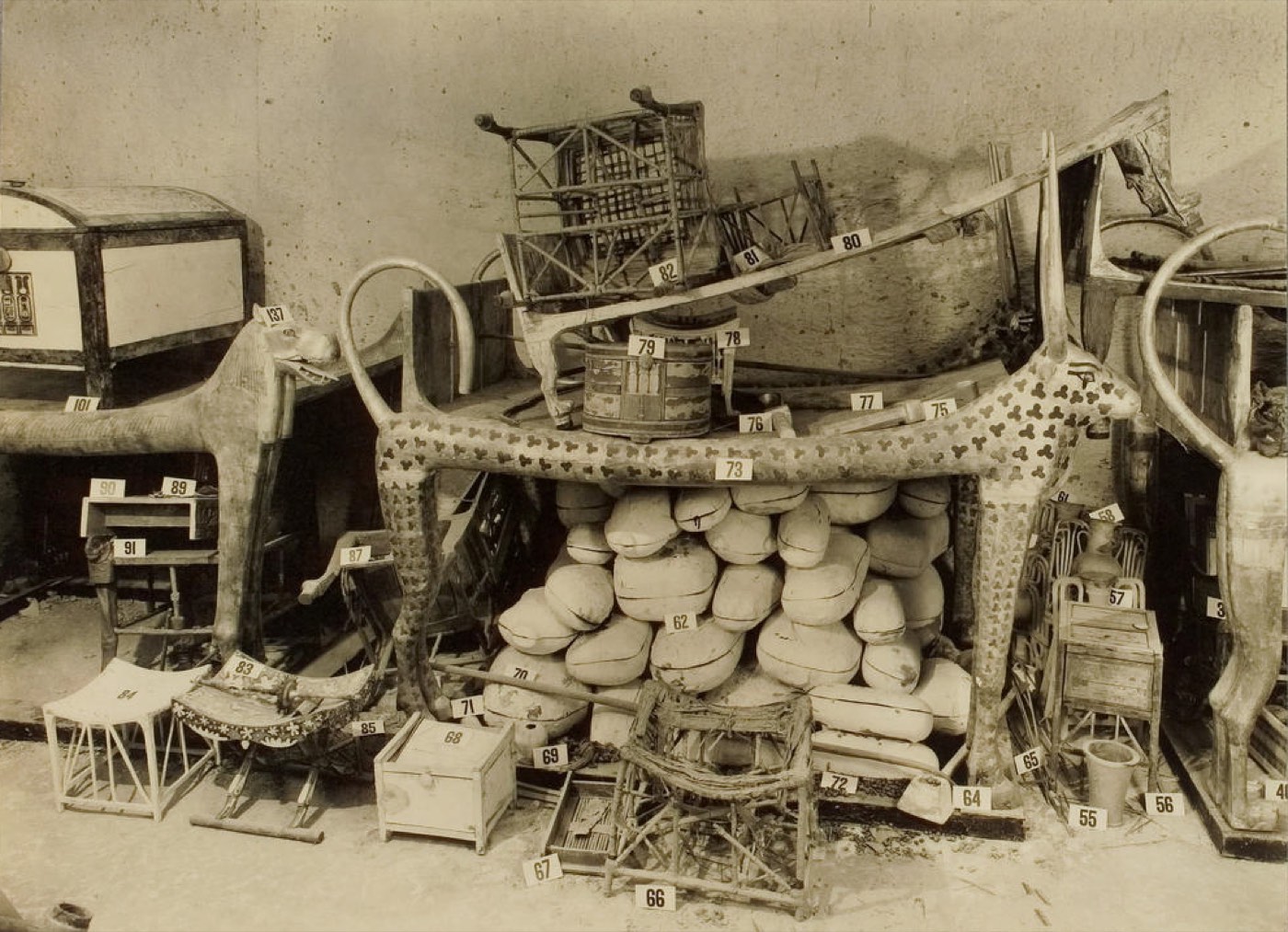
The antechamber as it was found, December 1922Harry Burton, 1922 · Public domainImage rights
Story·Common but wrong
Tutankhamun’s curse?
What people say
“Tutankhamun’s curse struck down those who opened his tomb.”
A published study found no statistical evidence that entering the tomb was linked to a shorter life. And the story itself was born in the newspapers, not in the inscriptions.12
How the story was born
Tutankhamun's tomb was opened in late 1922, and the world followed every step. Lord Carnarvon, who funded the excavation, had sold exclusive rights to The Times, so other newspapers looked for stories of their own. When Carnarvon died in Cairo on 5 April 1923, they had one: the pharaoh's curse. Over the next years almost every death of anyone linked to the tomb, however loosely, was added to the tale. No curse was written on the tomb's doors; the inscriptions quoted in the press were invented or misread.2
What the numbers said
In 2002 the epidemiologist Mark Nelson published a study in the BMJ of the 44 Westerners whom Carter recorded as present in Egypt during the key openings. The 25 who were exposed to the tomb died at an average age of 70, the others at 75, a difference that was not statistically significant. The study found no statistical evidence that entering the tomb was linked to a shorter life in the group it studied.1
What happened to Carnarvon, and to those who went in Details
Carnarvon had been in poor health for years. A mosquito bite on his cheek became infected after he nicked it while shaving; erysipelas followed, then blood poisoning and pneumonia. Howard Carter, who spent ten years in the tomb, lived until 1939; Lady Evelyn Herbert, Carnarvon's daughter and one of the first to enter, lived until 1980.2
What we know for sure
- Carnarvon’s death
- In Cairo, 5 April 1923, after blood poisoning and pneumonia2
- A written curse
- No curse was written on the tomb’s doors2
- The study
- The BMJ, 2002: 44 Westerners, and no statistically significant difference in their ages at death1
- Howard Carter
- Spent ten years in the tomb, and lived until 19392
What is said
That those who opened the tomb died of the pharaoh’s curse. The tale spread through the newspapers from 1923, and every death of anyone linked to the tomb was added to it.
Sources
Each source opens its own page.
Image rights
Photographed by Harry Burton during the excavation of Tutankhamun’s tomb (1922–1932). The photograph is in the public domain: the photographer died in 1940, and his work from the tomb was published in the 1920s.

Connected to it
Your name in hieroglyphs · SHETA: a puzzle game from SHATATiON