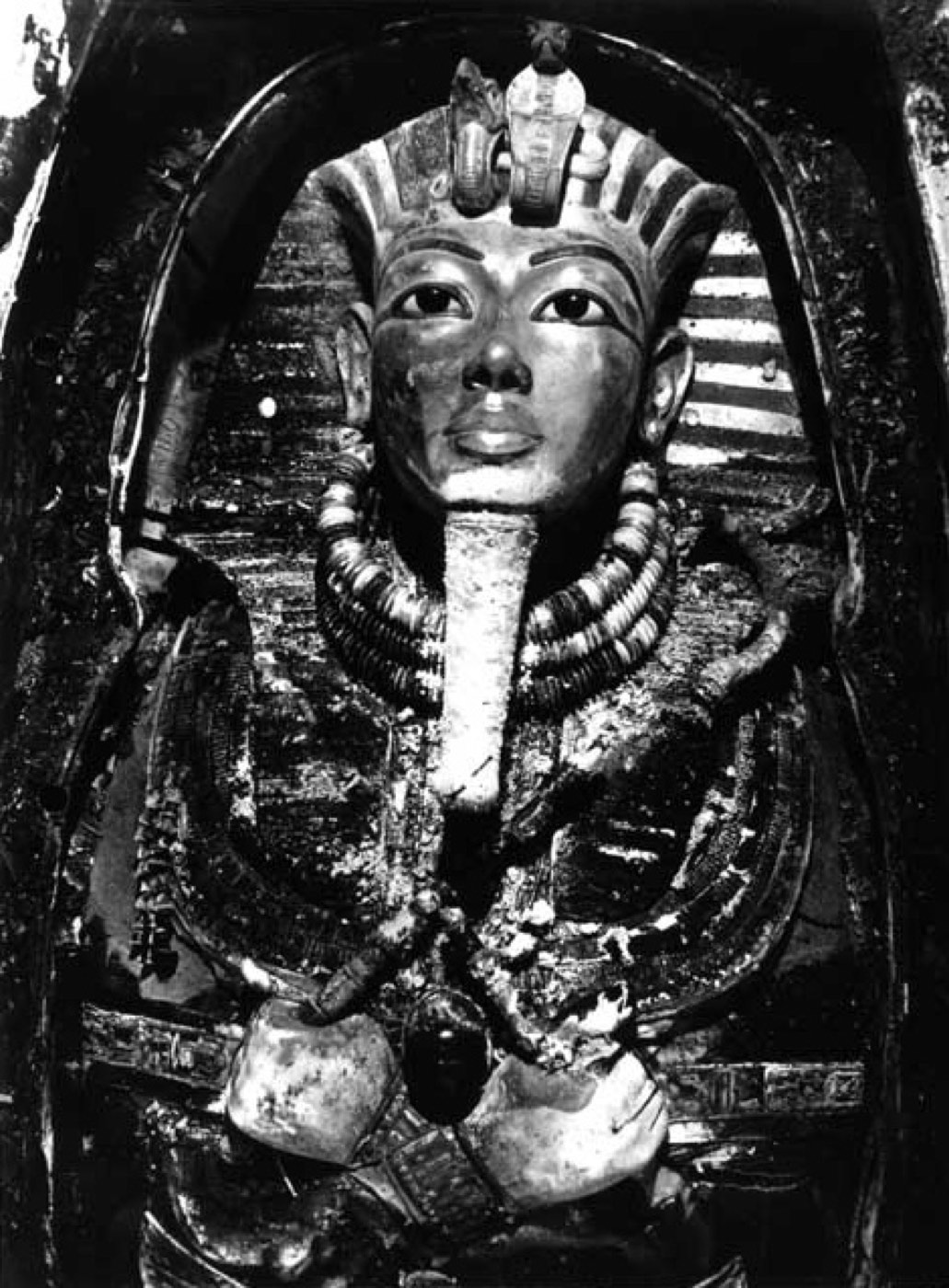
The mask on the mummy, October 1925Harry Burton, 1925 · Public domainImage rights
Piece·funerary mask·In Egypt
Tutankhamun's gold mask
Priceless, insured for a million
- Date
- c. 1323 BCE; 18th Dynasty, New Kingdom
- Where it is now
- Grand Egyptian Museum, Giza, Egypt (moved from the Egyptian Museum, Tahrir, in 2025)
Documented: This story has clear published sources.
This story’s sources (4 sources), each opens its own page:
- UK National Archives blog: 'A trickle of Pharaonic valuables'
- UK National Archives catalogue: FCO 39/999, Proposed exhibition of Tutankhamun relics at the British Museum in 1972
- Wikipedia: Mask of Tutankhamun (weight 10.23 kg, find date)
- Al-Monitor / AFP (Nov 2025): King Tut's collection displayed for first time at Egypt's grand museum
Scholars’ theory: An explanation scholars take seriously, but not settled.Folk tale: A story people tell; we give its origin and what is established.
It has no price on any market, because it can never be sold. Yet when it once travelled to London, it had to be given a number.
The day it appeared
The mask came to light on 28 October 1925, three years after the tomb was found, on the face of the mummy inside the innermost coffin, in Tutankhamun’s tomb in the Valley of the Kings. Howard Carter’s team was working there.3
Gold and stone
It is made of two layers of gold sheet, inlaid with lapis lazuli, quartz, obsidian and coloured glass, and it weighs about 10 kilograms.3
A number in London, 1972
When it travelled to the British Museum in 1972, it alone was insured for £1,000,000, out of £9,060,000 for the whole exhibition.12
A beard back on with beeswax A detail from 2014 and 2015
In August 2014 the mask's beard came off during work on its display case, and staff glued it back with too much epoxy. In 2015 a German-Egyptian team removed the glue with wooden tools and fixed the beard with beeswax, an adhesive used in antiquity. The study found the beard had already been detached before, and reattached only in 1946.78
Documented: This story has clear published sources.
This story’s sources (2 sources), each opens its own page:
- Ahram Online: Tutankhamun's gold mask restored after botched repair
- National Geographic: King Tut mask beard repaired (Dec 2015)
Scholars’ theory: An explanation scholars take seriously, but not settled.Folk tale: A story people tell; we give its origin and what is established.
Today
It was moved from the Egyptian Museum in Tahrir in 2025, and it has been on show at the Grand Egyptian Museum since the museum opened to the public on 4 November 2025.4
What we know for sure
- Type
- funerary mask
- Material
- two layers of gold sheet, inlaid with lapis lazuli, quartz, obsidian and coloured glass3
- Date
- c. 1323 BCE; 18th Dynasty, New Kingdom
- Found
- Tomb KV62, Valley of the Kings, Luxor; 28 October 1925 (tomb found 1922); Howard Carter3
- Now
- Grand Egyptian Museum, Giza, Egypt (moved from the Egyptian Museum, Tahrir, in 2025)4
- Inventory no.
- JE 60672
Still argued over
Made for Nefertiti?
Some Egyptologists, led by Nicholas Reeves in 2015, think the mask was first made for Nefertiti, and that Tutankhamun's face was added later. They point to a name on it that seems re-cut over an older one. Others disagree: this is a scholars' theory, not a settled fact.56
Scholars’ theory: An explanation scholars take seriously, but not settled.
This story’s sources (2 sources), each opens its own page:
- Ahram Online: Tutankhamun's treasures may have originally belonged to his stepmother
- Reeves, Journal of Ancient Egyptian Interconnections (2015), The Gold Mask of Ankhkheperure Neferneferuaten
Documented: This story has clear published sources.Folk tale: A story people tell; we give its origin and what is established.
Sources
Each source opens its own page.
- UK National Archives blog: 'A trickle of Pharaonic valuables'
- UK National Archives catalogue: FCO 39/999, Proposed exhibition of Tutankhamun relics at the British Museum in 1972
- Wikipedia: Mask of Tutankhamun (weight 10.23 kg, find date)
- Al-Monitor / AFP (Nov 2025): King Tut's collection displayed for first time at Egypt's grand museum
- Ahram Online: Tutankhamun's treasures may have originally belonged to his stepmother
- Reeves, Journal of Ancient Egyptian Interconnections (2015), The Gold Mask of Ankhkheperure Neferneferuaten
- Ahram Online: Tutankhamun's gold mask restored after botched repair
- National Geographic: King Tut mask beard repaired (Dec 2015)
Image rights
Photographed by Harry Burton during the excavation of Tutankhamun’s tomb (1922–1932). The photograph is in the public domain: the photographer died in 1940, and his work from the tomb was published in the 1920s.

Also shown in
Separate from the piece
Write your name under this piece
Your name is carved in hieroglyphs in a cartouche under a drawn design inspired by this piece, on the name page. The name is not part of the original inscription, and the design is an artwork, not a photograph of the piece.
You haven’t written your name yet.
Write your name under this pieceSHETA: a puzzle game from SHATATiON, with the same signs. Meet SHETA