Home / Halls / Tutankhamun’s treasures
Hall · 18 stories
Tutankhamun’s treasures
In November 1922 the door of a small tomb in the Valley of the Kings was opened. Inside were some 5,000 objects of a king who died young. Here are their stories: what stayed in Egypt, what left it, and what became a mystery.
To the pieces ↓
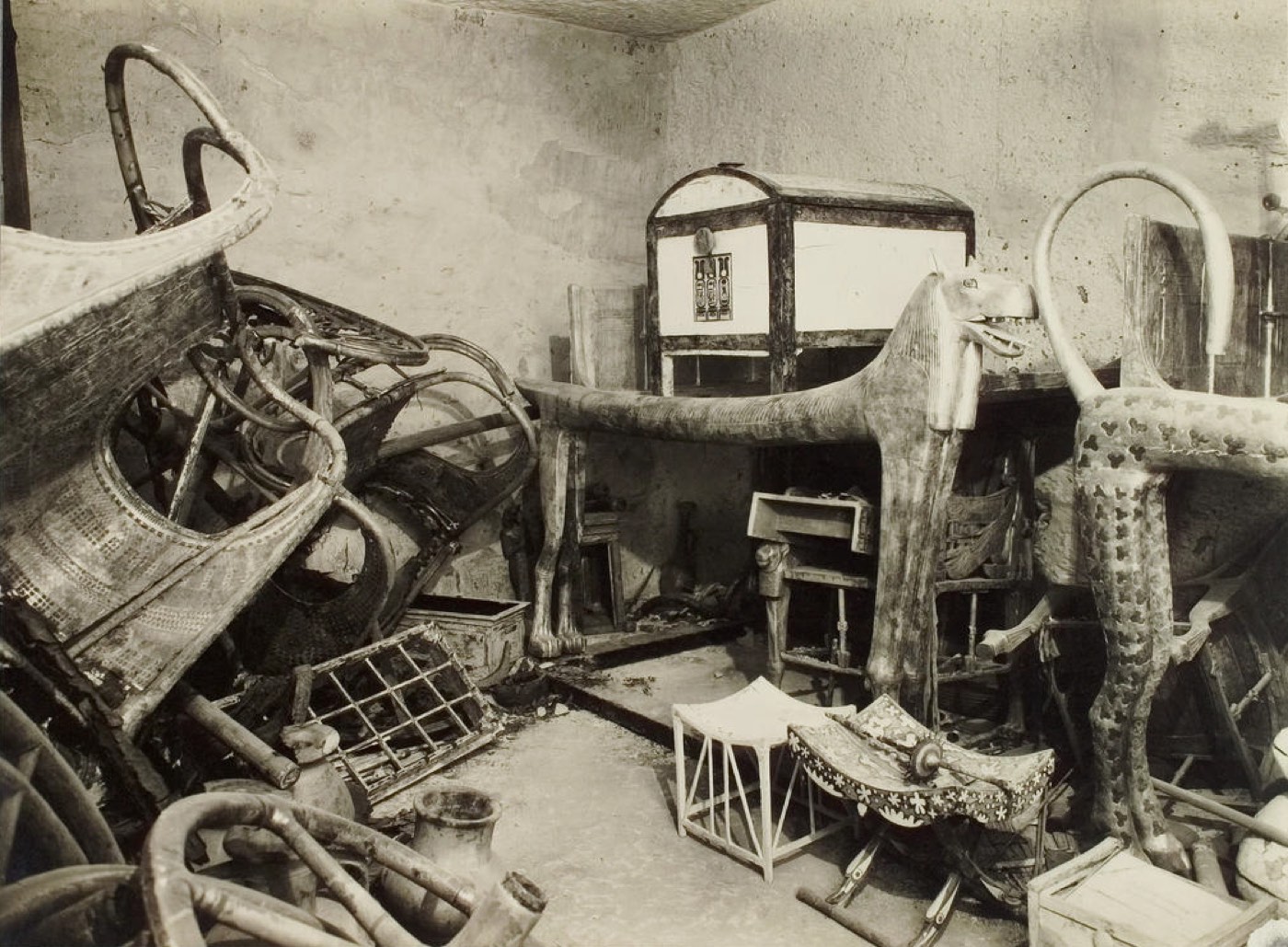
The antechamber as it was found, December 1922 Harry Burton, 1922 · Public domain
Search Tutankhamun’s treasures
All 18
In Egypt 9
Left, or came back 5
Mysteries and tales 4
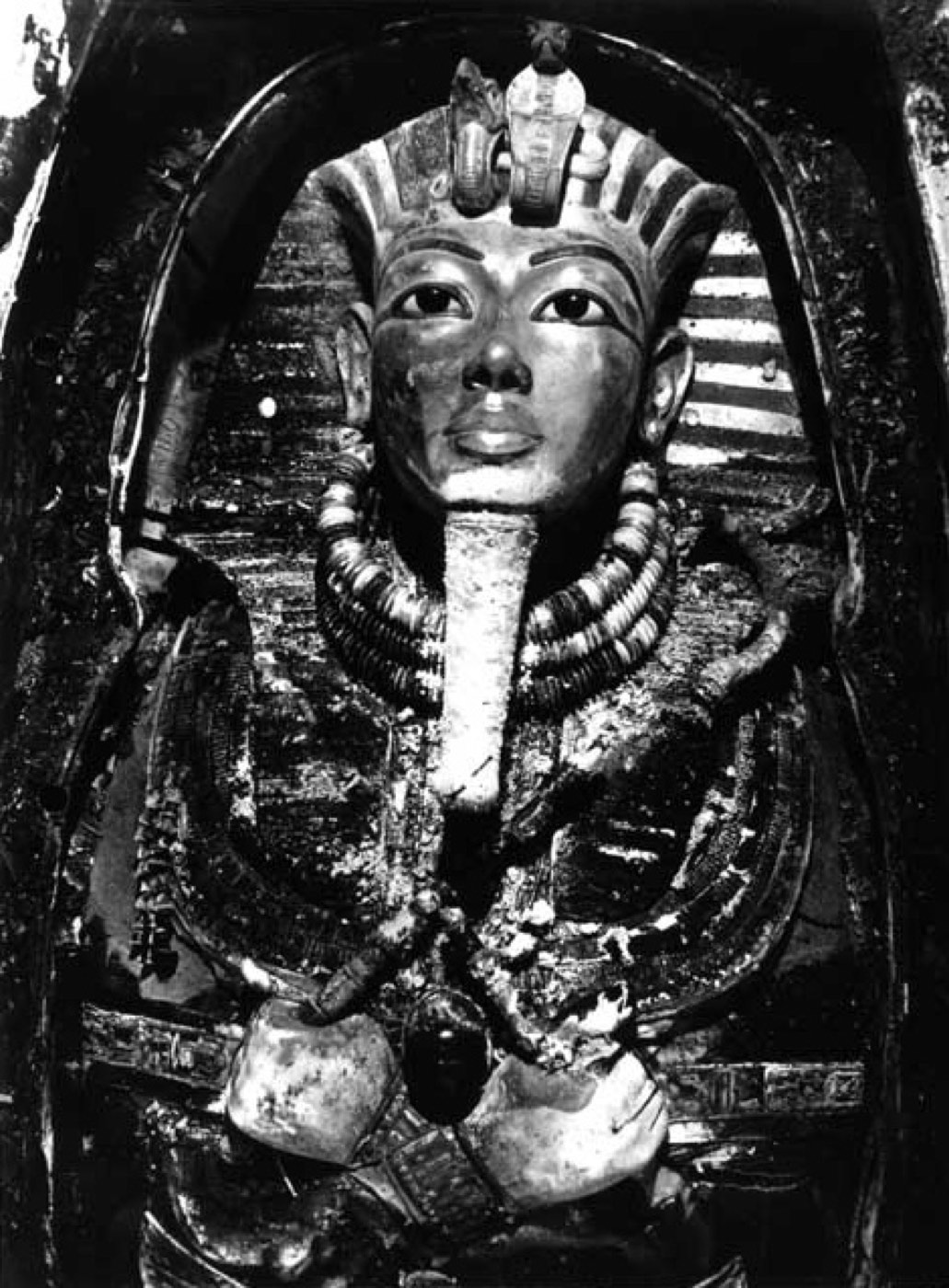
The mask on the mummy, October 1925 Harry Burton, 1925 · Public domain
01 Tutankhamun's gold mask
Priceless, insured for a million Tutankhamun's mask has no market price: it can never be sold. When it travelled to the British Museum in 1972, it alone was insured for £1,000,000, out of £9,060,000 for the whole exhibition. It is made of gold and weighs about 10 kg.
Grand Egyptian Museum, Giza
Documented: This story has clear published sources.
This story’s sources (4 sources), each opens its own page:
The piece’s page→
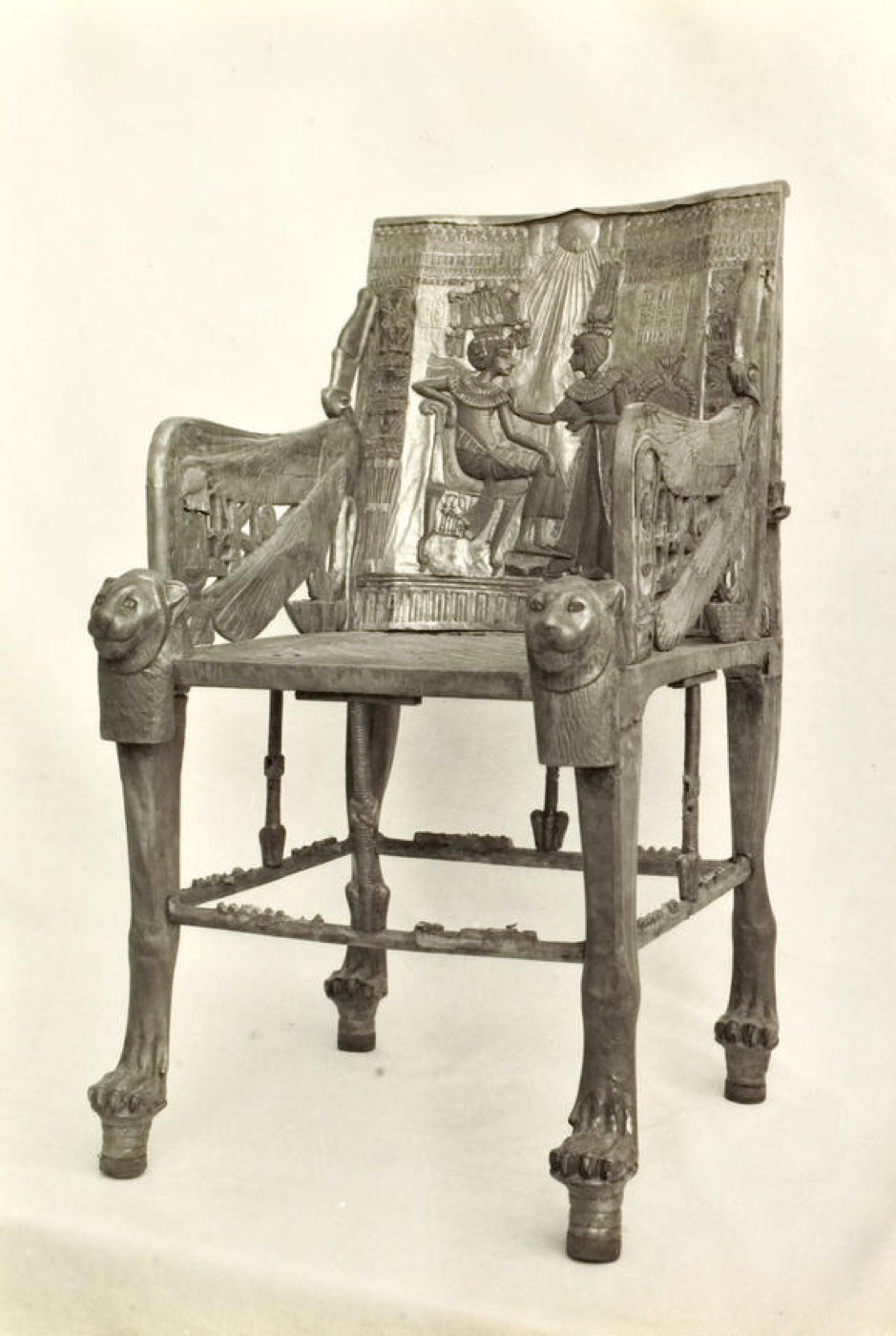
The throne, photographed by Burton Harry Burton, 1923 · Public domain
02 Tutankhamun's golden throne
A throne that kept the old names On the back of the throne, Queen Ankhesenamun touches her husband's shoulder with perfumed oil, under the rays of the sun disc Aten.
Grand Egyptian Museum, Giza
Documented: This story has clear published sources.
This story’s sources (3 sources), each opens its own page:
The piece’s page→
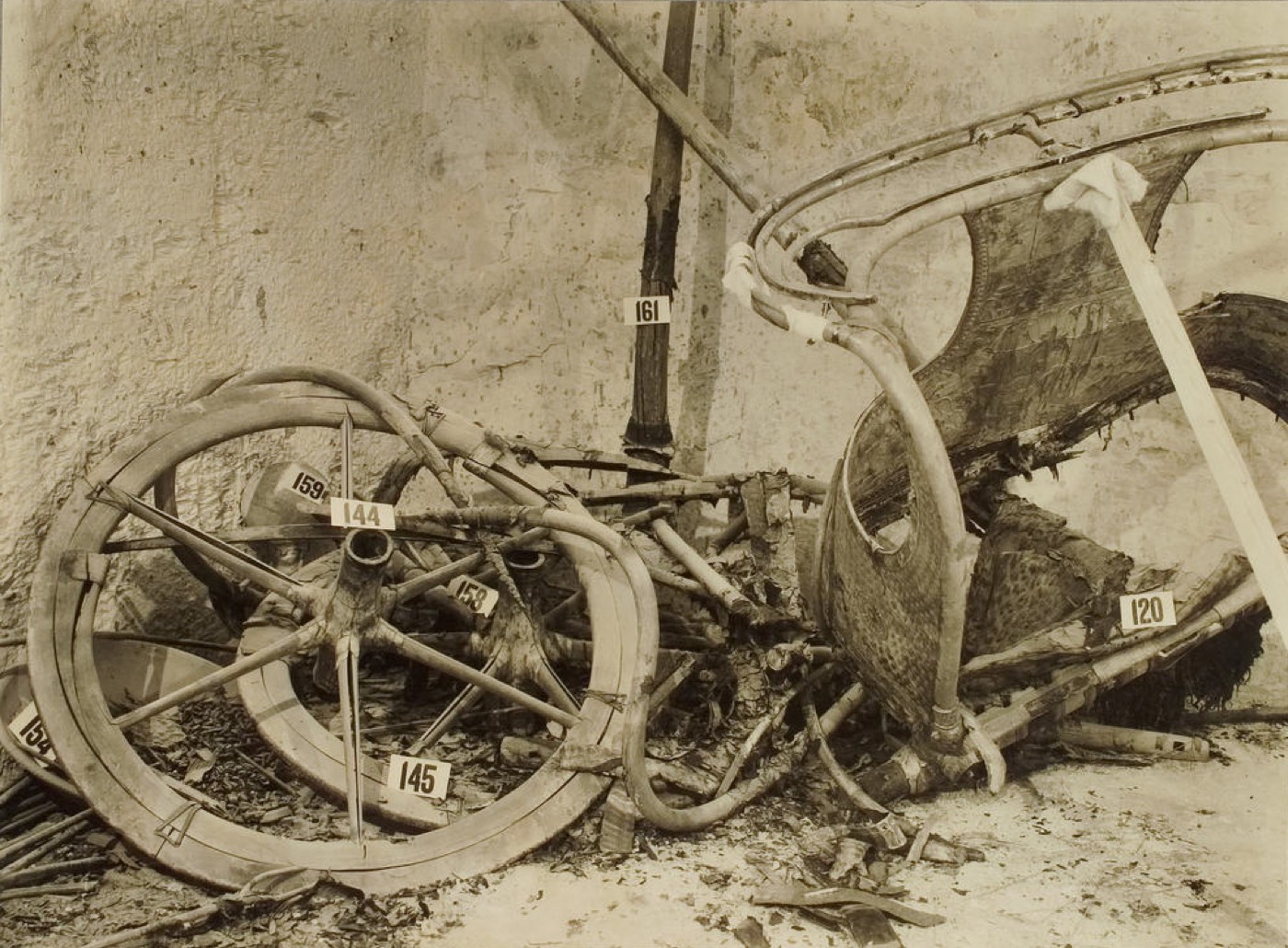
The chariots, dismantled, as found in 1922 Harry Burton, 1922 · Public domain
03 Tutankhamun's six chariots
Six chariots, together again Six chariots were found in Tutankhamun's tomb: some for ceremonies, some for hunting, and one lighter and faster for war.
Grand Egyptian Museum, Giza
Documented: This story has clear published sources.
This story’s sources (3 sources), each opens its own page:
The piece’s page→
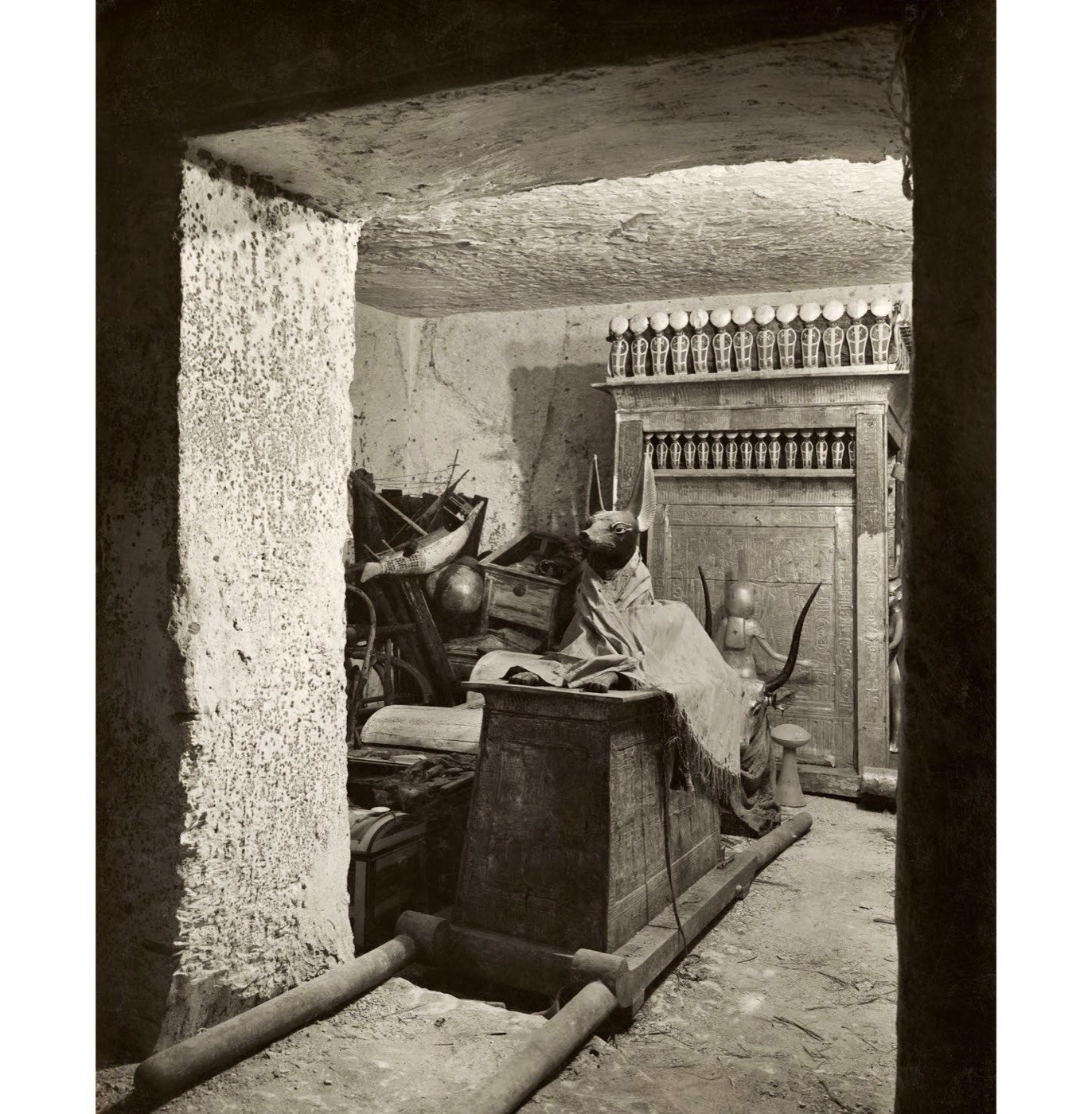
Anubis at the door of the Treasury Harry Burton · Public domain
04 The Anubis shrine of Tutankhamun
The jackal at the treasure door A black jackal, the god Anubis, lay on a gilded chest facing the burial chamber, guarding the door of the Treasury. He was draped in a linen shawl, and the chest under him held amulets and jewellery. The whole shrine sits on carrying poles, so priests could carry it in the funeral procession.
Grand Egyptian Museum, Giza
Documented: This story has clear published sources.
This story’s sources (3 sources), each opens its own page:
The piece’s page→
At the Grand Egyptian Museum 05 Tutankhamun's innermost coffin (solid gold)
110 kilos of gold Tutankhamun lay inside three coffins, one within the other.
Grand Egyptian Museum, Giza
Documented: This story has clear published sources.
This story’s sources (4 sources), each opens its own page:
The piece’s page→
06 Tutankhamun's two guardian statues
Two black guards at a sealed door When Carter's team entered the antechamber in 1922, two life-size figures of the king, 192 cm tall, stood facing each other on either side of a sealed door.
Grand Egyptian Museum, Giza
Documented: This story has clear published sources.
This story’s sources (3 sources), each opens its own page:
The piece’s page→
07 Tutankhamun's four gilded shrines
Boxes inside boxes The burial chamber was almost filled by four gilded shrines, each fitting inside the next, around the stone sarcophagus and its three coffins.
Grand Egyptian Museum, Giza
Documented: This story has clear published sources.
This story’s sources (2 sources), each opens its own page:
The piece’s page→
08 Head of Tutankhamun emerging from a lotus
Found in a wine crate This lovely small head shows the boy king rising from a lotus flower, like the sun god at the first sunrise.
Grand Egyptian Museum, Giza
Documented: This story has clear published sources.
This story’s sources (4 sources), each opens its own page:
The piece’s page→
09 Tutankhamun's iron dagger
A blade from the sky In 2016, scientists scanned Tutankhamun's iron dagger without touching it.
Grand Egyptian Museum, Giza
Documented: This story has clear published sources.
This story’s sources (3 sources), each opens its own page:
The piece’s page→
Mysteries around the tomb 10 Tutankhamun's trumpets
The trumpet blamed for wars In April 1939 the BBC broadcast Tutankhamun's trumpets live to an estimated 150 million listeners; the lights failed and one trumpet shattered.
Grand Egyptian Museum, Giza
Also in: Mysteries and tales
Folk tale: A story people tell; we give its origin and what is established.
This story’s sources (2 sources), each opens its own page:
The piece’s page→
11 The curse of the pharaohs
Did the tomb kill its finders? When Lord Carnarvon, who paid for the dig, died in Cairo in April 1923, newspapers blamed a pharaoh's curse.
Valley of the Kings, Luxor
Also in: Mysteries and tales
Folk tale: A story people tell; we give its origin and what is established.
This story’s sources (2 sources), each opens its own page:
The story’s page→
12 How did Tutankhamun die?
Murder, chariot or malaria? Tutankhamun died at about 19.
Valley of the Kings, Luxor
Also in: Mysteries and tales
Scholars’ theory: An explanation scholars take seriously, but not settled.
This story’s sources (2 sources), each opens its own page:
The piece’s page→
13 Hidden chambers in Tutankhamun's tomb?
A door behind the paintings? In 2015 the Egyptologist Nicholas Reeves saw what looked like the outlines of two blocked doors in high-resolution scans of the burial chamber walls, and suggested that Nefertiti might lie beyond.
Valley of the Kings, Luxor
Also in: Mysteries and tales
Scholars’ theory: An explanation scholars take seriously, but not settled.
This story’s sources (2 sources), each opens its own page:
The piece’s page→
Pieces that left Egypt, and pieces that came back 14 Nineteen objects from Tutankhamun's tomb (from the Met)
Never meant to leave Everything in Tutankhamun's tomb was supposed to stay in Egypt.
Egyptian Museum, Cairo
Also in: Returned to Egypt
Documented: This story has clear published sources.
This story’s sources (3 sources), each opens its own page:
The piece’s page→
15 Colossal statue of Tutankhamun (Chicago)
A boy king, renamed twice This 5-metre statue shows Tutankhamun, but the name on it is Horemheb's, carved over Ay's: two later kings claimed it in turn.
Institute for the Study of Ancient Cultures
Also in: Abroad
Documented: This story has clear published sources.
This story’s sources (2 sources), each opens its own page:
The piece’s page→
16 Quartzite head of Tutankhamun (Christie's 2019)
Sold while Egypt objected In July 2019, Christie's in London sold a 28.5 cm quartzite head with Tutankhamun's face for about £4.7 million, as protesters stood outside.
Unknown: private buyer since July 2019
Also in: Disputed
Documented: This story has clear published sources.
This story’s sources (2 sources), each opens its own page:
The piece’s page→
17 Pink granite stela of Tutankhamun (Louvre Abu Dhabi)
The stela behind a Paris investigation In 2016 the Louvre Abu Dhabi paid about €8.5 million for a pink granite stela bearing Tutankhamun's name.
Louvre Abu Dhabi, United Arab Emirates
Also in: Disputed
Documented: This story has clear published sources.
This story’s sources (6 sources), each opens its own page:
The piece’s page→
18 The whm amulet and the Tutankhamun pieces that left with Carter
‘Undoubtedly stolen’ In 1934 the Egyptologist Alan Gardiner wrote to Howard Carter that an amulet Carter had given him had been 'undoubtedly stolen from the tomb of Tutankhamun'.
Unknown
Also in: Whereabouts unknown
Documented: This story has clear published sources.
This story’s sources (2 sources), each opens its own page:
The piece’s page→
Show the rest of the stories
No piece in this hall matches that. Try another word, or choose “All”.
A project
Hekayet Athar is a SHATATiON project, with the game SHETA. The stories come from published sources, and each one shows its sources and its trust level.
Photographs
Harry Burton, 1922 · Public domain : The antechamber as it was found, December 1922. Source Harry Burton, 1925 · Public domain : The mask on the mummy, October 1925. Source Harry Burton, 1923 · Public domain : The throne, photographed by Burton. Source Harry Burton, 1922 · Public domain : The chariots, dismantled, as found in 1922. Source Harry Burton · Public domain : Anubis at the door of the Treasury. Source Hekayet Athar Stories Every piece Your name in hieroglyphs SHETA Harry Burton’s photographs of the excavation, 1922–1925, are in the public domain. Every piece has one page and one fixed address, whichever halls it shows in.