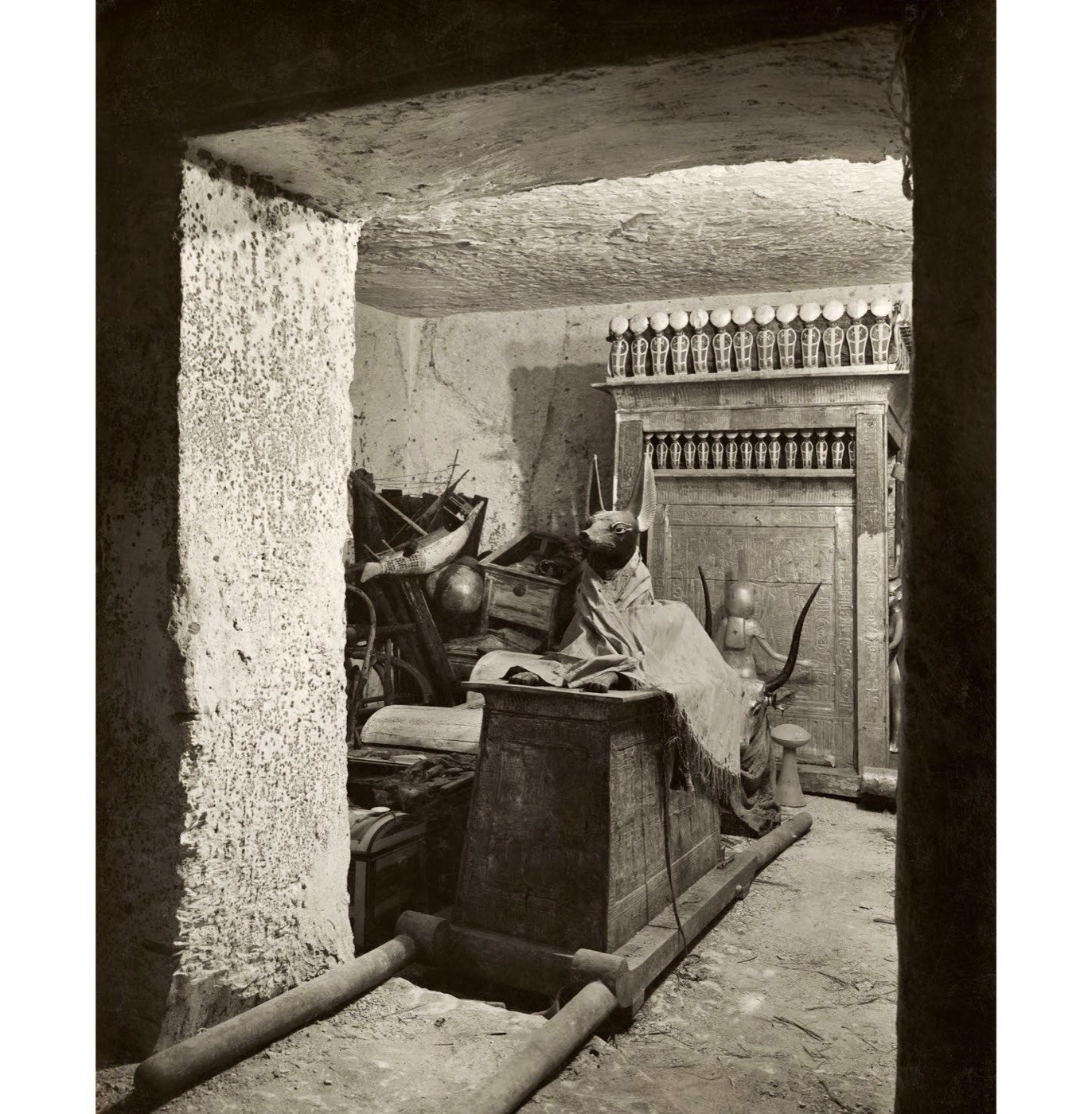
Anubis at the door of the TreasuryHarry Burton · Public domainImage rights
Piece·portable shrine with a recumbent jackal (Anubis) on carrying poles·In Egypt
The Anubis shrine of Tutankhamun
The jackal at the treasure door
- Date
- c. 1323 BCE; 18th Dynasty
- Where it is now
- Grand Egyptian Museum, Giza, Egypt (moved from the Egyptian Museum, Tahrir)
Documented: This story has clear published sources.
This story’s sources (3 sources), each opens its own page:
- Griffith Institute, Tutankhamun archive: object 261 (Cairo JE 61444; GEM 6)
- Wikipedia: Anubis Shrine
- Al-Monitor / AFP (Nov 2025): King Tut's collection displayed for first time at Egypt's grand museum
Scholars’ theory: An explanation scholars take seriously, but not settled.Folk tale: A story people tell; we give its origin and what is established.
The story
A black jackal, the god Anubis, lay on a gilded chest facing the burial chamber, guarding the door of the Treasury. He was draped in a linen shawl, and the chest under him held amulets and jewellery. The whole shrine sits on carrying poles, so priests could carry it in the funeral procession.
What we know for sure
- Type
- portable shrine with a recumbent jackal (Anubis) on carrying poles
- Material
- wood covered with black resin and gold; eyes of calcite, obsidian and silver
- Date
- c. 1323 BCE; 18th Dynasty
- Found
- Entrance of the Treasury, tomb KV62 (Carter's object 261); 1926–1927 (Treasury cleared); Howard Carter
- Now
- Grand Egyptian Museum, Giza, Egypt (moved from the Egyptian Museum, Tahrir)
- Inventory no.
- JE 61444
Sources
Each source opens its own page.
Image rights
Photographed by Harry Burton during the excavation of Tutankhamun’s tomb (1922–1932). The photograph is in the public domain: the photographer died in 1940, and his work from the tomb was published in the 1920s.

Also shown in
Separate from the piece
Write your name under this piece
Your name is carved in hieroglyphs in a cartouche under a drawn design inspired by this piece, on the name page. The name is not part of the original inscription, and the design is an artwork, not a photograph of the piece.
You haven’t written your name yet.
Write your name under this pieceSHETA: a puzzle game from SHATATiON, with the same signs. Meet SHETA